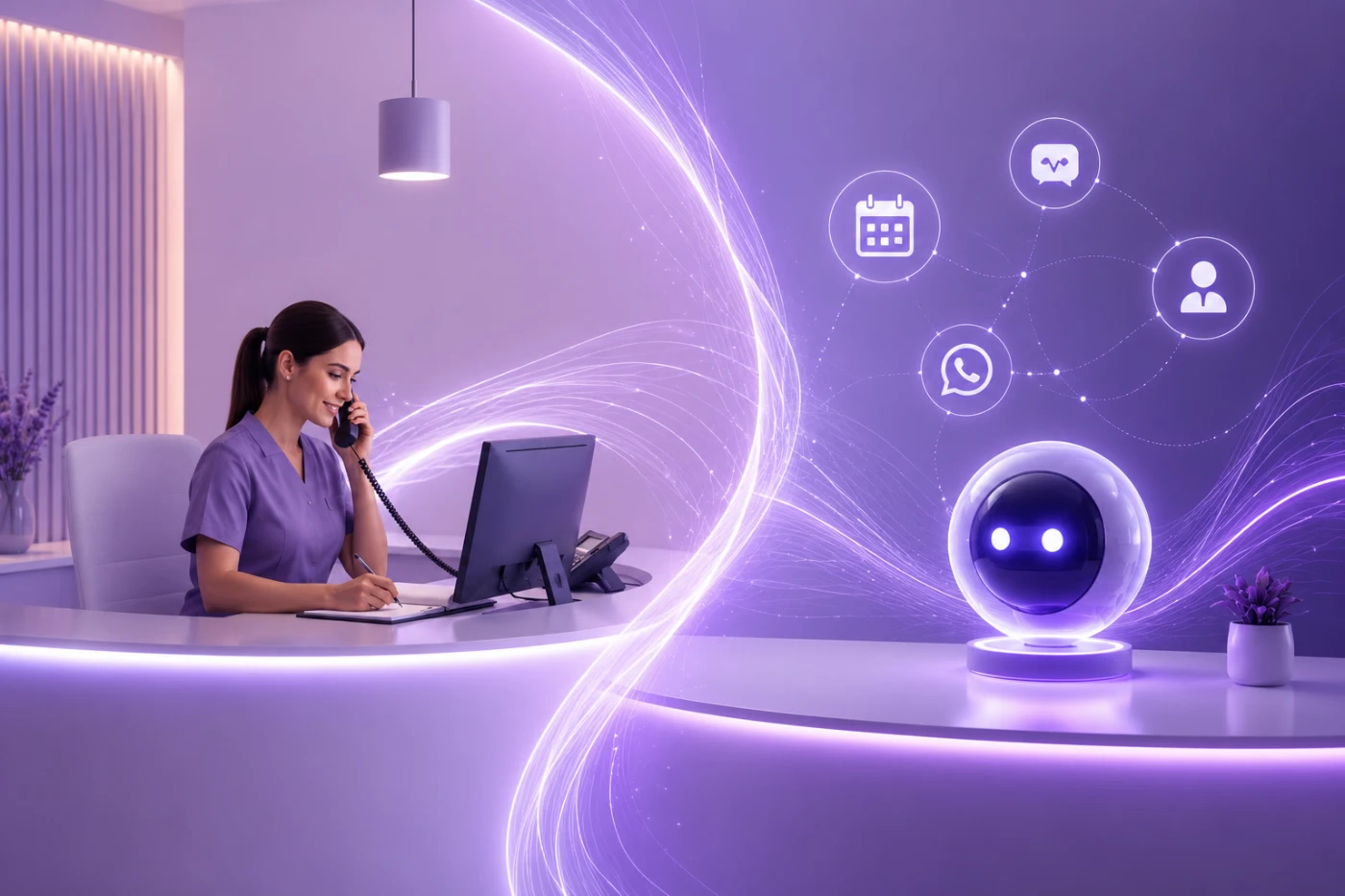
The Evolution of Patient Care: From the Human Receptionist to the AI Agent
For decades, the front door of any practice was a person behind a desk or on the other end of a phone line. That person screened inquiries, booked appointments, calmed nerves, and carried, through sheer availability, a large share of the practice’s reputation. The model worked as long as call volume stayed manageable and patients tolerated waiting. Neither condition holds anymore.
The Phone Rings and Nobody Picks Up
Notifire’s analysis of missed calls in U.S. medical practices found that the average practice misses between 15% and 30% of incoming calls during business hours, and that number climbs past 40% in solo practices and small offices with a single front-desk staffer. The same report puts a hard number on what happens next: when a call goes unanswered and the patient doesn’t leave a voicemail, the odds of that call ever turning into a booked appointment drop below 5%. Patient behavior backs that up, since most callers today simply don’t leave messages anymore — they hang up and try the next practice on their list, and that practice usually answers.
Industry data compiled by Playmedic, drawing on call-center audits across medical centers, adds a second layer to the problem: roughly 90% of missed calls are never returned. That’s not a staffing failure or a sign that front-desk teams don’t care. It’s what happens when the same person answering the phone is also checking in patients, collecting payments, and putting together treatment estimates, all at the same time, during the exact hours when call volume peaks — first thing in the morning, around lunch. Running the math on a mid-sized practice taking 50 calls a day, a 15% miss rate works out to roughly 7.5 missed calls daily, and at an average of $250 in immediate revenue potential per new-patient call, that adds up to real money walking out the door every year, before even counting referrals, recurring visits, and the lifetime value of a new patient relationship.
Sixty Seconds Decide Whether a Patient Stays or Leaves
The channel shifted before most practices adjusted their processes to match it. Patients increasingly text before they call, and they arrive with a level of urgency that has nothing to do with how a phone call used to work. Playmedic’s research on WhatsApp response times found that a first-response time over five minutes cuts conversion probability by 65%, and that conversations answered within five minutes close at three times the rate of those that take longer than half an hour. Aurorainbox’s 2026 breakdown of messaging response data cites the widely referenced Harvard Business Review study, updated for chat-based lead response: a lead answered within one minute is eight times more likely to qualify than one answered after five minutes, and every additional minute of delay shaves 3% to 5% off the probability of closing. After 30 minutes without a response, 70% of leads have already gone cold. By four hours, 90% are considered lost for good.
The same analysis notes that average response time for practices without any automation runs around 18 minutes. With an AI agent handling the channel, that number drops to 90 seconds. The gap between those two figures isn’t a technical footnote — it’s the difference between a patient who books with your practice and one who books with a competitor while still waiting to hear back.
A Receptionist That Doesn’t Sleep, Doesn’t Take Lunch, and Doesn’t Handle One Conversation at a Time
That’s the gap an AI-powered conversational agent fills, one trained on a specific practice’s tone, services, and information, running around the clock across WhatsApp, Instagram, and the practice’s website. It doesn’t replace the human touch once a patient is in the chair with a provider. It replaces the screening and first-contact function that used to depend entirely on whether a staff member happened to be free at that exact moment. A patient texting at 11 p.m. asking about pricing for a procedure gets an immediate, accurate answer specific to that practice, not a generic script pulled from a manual.
What sets this layer of care apart from a basic FAQ chatbot is that it feeds a CRM that logs every conversation, classifies each patient by intent — general inquiry, booking request, post-treatment follow-up — and places them in a pipeline with defined stages. That classification isn’t administrative busywork. It’s what keeps a lead from sitting untouched, which is exactly where most practices bleed revenue without noticing: the conversation that started well but never got closed because nobody circled back.
What Changes When Booking Doesn’t Require Leaving the Chat
One of the most underestimated friction points in digital patient acquisition is the moment a conversation gets interrupted so the patient can be redirected to an outside booking tool. Aurorainbox’s research on WhatsApp-based scheduling systems found that when the flow breaks to send a patient to an external calendar link like Calendly, between 30% and 40% of patients drop off before completing the booking. That friction hits harder with older patients and anyone less comfortable navigating multiple apps and platforms, which describes a meaningful share of the patient base at most medical and aesthetic practices.
A scheduling calendar that runs inside the same conversation — no redirect to another platform, no separate app download, no standalone form — removes that drop-off point entirely. The same report found that, across real operations at practices with 3 to 10 providers, lead-to-booked-appointment conversion rose from a 35-40% range to 60-75% once that outside jump was eliminated. The appointment gets confirmed in the same thread where the conversation started, and the reminder goes out afterward without anyone on staff needing to remember to send it.
The Reminders That Keep the Schedule From Quietly Leaking
Research compiled by Playmedic, citing studies published through Elsevier, puts the no-show rate at private practices without active no-show management between 12% and 19%, representing a monthly loss of $2,500 to $7,500 per location. Only 41% of medical centers reach out to patients ahead of appointments to confirm attendance, according to the same data. The rest operate on the hope that patients remember on their own, which holds up right until it doesn’t, and by then the open slot can’t be filled that day.
An automated reminder system that fires without manual intervention — 24 hours ahead, with the specifics of that appointment: time, provider, what to bring — turns confirmation into something that no longer depends on a staff member remembering to do it between everything else on their plate. Vitaldent, after rolling out appointment automation through WhatsApp, logged a confirmed-appointment increase of more than 70% along with a notable drop in no-shows, per Playmedic’s analysis. Practices that adopt AI-driven no-show management cut their no-show rate by as much as 50% within six months, according to data reported by Libertad Digital and cited in that same research.
The Patient Who Already Came In But Nobody Followed Up With
There’s a third blind spot that rarely gets the same attention as missed calls or no-shows: the patient who already visited, left satisfied, and simply drifted away because nobody reached back out. Reactivating that base shouldn’t require another dollar of ad spend. The cost of winning back a patient who already knows the practice, already trusts the provider, and already went through the initial decision process is a fraction of the cost of acquiring a new lead from scratch. An automated sequence that flags inactive patients based on time since their last visit and reaches out with something relevant — a follow-up check-in, a complementary treatment, a seasonal offer — turns that dormant list into recurring revenue without spending another cent on advertising.
Davix documented that practices actively communicating with patients through WhatsApp report Net Promoter Score increases of up to 30 points, the standard measure of satisfaction and loyalty. That number matters because a patient who feels looked after between visits is also the one who refers family and friends, and referrals remain one of the most cost-effective acquisition channels in healthcare.
If you want to see exactly how many leads your practice is losing right now, and at which point in the conversation they’re slipping away, Floix Growth can run that diagnostic with you, using your practice’s actual numbers. That’s always the right starting point — your data, not an industry average.
Frequently Asked Questions
What is a virtual receptionist for clinics? It’s a conversational AI agent configured with a specific practice’s tone, services, and information, handling patient inquiries across WhatsApp, Instagram, and web chat around the clock, classifying leads, booking appointments within the same conversation, and sending automated reminders.
Does it fully replace human front-desk staff? No. It handles first contact, inquiry classification, and scheduling — the tasks that overwhelm human staff during peak hours. That frees the front-desk team to focus on in-person care and situations that genuinely need a human judgment call.
How long does it take to set up in a practice? It depends on service volume and how complex the booking flow is, but initial setup — training the agent on the practice’s information, connecting channels, and linking the calendar — typically wraps up within a few weeks.
Does it work the same way for a medical practice as for an aesthetic clinic? The core function is the same: screen inquiries, book appointments, and follow up. What changes is tone, the most common questions, and lead classification criteria, all configured around each specialty’s typical patient profile.
How do you measure whether it’s working? With concrete metrics: percentage of conversations answered within one minute, lead-to-booked-appointment conversion rate, confirmation and no-show rates, and the volume of patients reactivated without additional ad spend. All of it is tracked inside the integrated CRM.
We diagnose your operation and show you exactly which module solves your bottleneck.
