Most clinics answer this question once a year, when someone on the team exports the database and runs a campaign targeting everyone who “hasn’t been in a while.” That logic puts a patient who had neurotoxin three months ago in the same list as someone who abandoned an orthodontic plan eighteen months back — and sends them both the same message. The low response rate that follows usually gets read as proof that reactivation doesn’t work, when what failed was the timing logic.
Useful timing is built on the clinical cycle of each treatment, because that cycle determines when the patient starts to feel like something is missing. When a message arrives inside that window, it lands alongside a need the patient is already experiencing. When it arrives six months after the window closed, it competes against a decision the patient already made elsewhere, or against a new habit that replaced the visit.
A patient is inactive when they have exceeded the expected return interval for their treatment without rebooking. The right moment to contact them is two to four weeks after the end of that clinical interval. For neurotoxin, whose effect the American Academy of Dermatology places at approximately three to four months, the contact window opens around month four. For a routine dental checkup, traditionally set at six months, it opens around month seven. The interval changes with each procedure; the calculation logic stays identical.
Every Procedure Comes With Its Own Clock
The American Academy of Dermatology places the duration of cosmetic botulinum toxin’s facial effect at approximately three to four months, and notes that a single underarm hyperhidrosis treatment can provide up to six months of relief. Those are two distinct reactivation windows within the same patient, and a clinic that treats them the same will contact her too early in one case and too late in the other.
In dentistry, the traditional six-month benchmark has less scientific backing than it’s usually given credit for. The 2020 Cochrane review on recall intervals by Fee and colleagues found high-certainty evidence that, for adults, six-month and risk-adjusted recall intervals produce little to no difference in tooth surfaces with caries, gingival bleeding, or oral-health-related quality of life over a four-year period. That conclusion hands the clinic an operational decision: assign each patient a personal return interval based on their risk profile and treatment, and record it in their chart at discharge.
That recorded interval is where any workable reactivation system actually starts. Without an expected return date stored per patient, the clinic has no way of knowing who is overdue and who is still within their normal cycle. Every conversation about “how long to wait” depends on that data point existing before the patient walks out the door.
The Four Weeks After the Cycle Ends
The highest-yield window opens two to four weeks after the expected return date. At that point, the patient is noticing the decline of their result or the discomfort that brought them in originally, still remembers the provider who treated them, and hasn’t yet arranged an alternative. The message lands as continuity of something already in motion — it doesn’t need to justify itself.
The economics behind that window are well established. Research by Frederick Reichheld and Earl Sasser, published in Harvard Business Review in 1990, showed that reducing customer defection by 5% raised profits by 25% to 85% depending on the sector — a range Bain & Company later extended to 25% to 95%. Harvard Business Review also documents that acquiring a new customer costs five to twenty-five times more than retaining an existing one. Applied to a clinic, every patient recovered inside their natural window avoids an acquisition cost that was already paid once.
Contacting before the cycle ends carries a different, equally real cost: the patient reads the message as commercial pressure around a need they don’t yet have, and the clinic burns contact permission it will need later.
Three Months Out: The Patient Still Has You in Mind
For short-cycle procedures, three months of absence already means a patient is overdue. The message that works in this range operates on result continuity and on the specifics of the patient’s history. Referencing the exact date of the last session, the procedure performed, and the point at which that result starts to fade produces a different response than a generic reminder.
A formulation that performs in this range: “Hi Sarah — at your last session on March 12th we worked on your glabella and crow’s feet. That effect usually starts to fade between months three and four, so you’re right at the point where it’s worth maintaining it before the muscle regains strength. Want me to hold a slot for you this week or next?”
That message includes no discount, and it shouldn’t. A patient at the three-month mark is still in an active relationship with the clinic, and offering a price reduction at this stage trains the entire base to wait for a promotion before rebooking. The incentive stays in reserve for ranges where inertia is harder to break.
Six Months Out: The Message Needs a New Reason
At six months, the result of most aesthetic procedures has fully reversed and the patient has normalized how they look now. A maintenance reminder loses its footing because there’s nothing left to maintain — the message needs to bring information the patient didn’t have when they stopped coming.
The options that support a six-month message are concrete: a no-cost assessment of current skin or dental status, a treatment that was budgeted but never executed, a protocol or technology the clinic added after the patient’s last visit, or a result the patient mentioned wanting that got recorded in the chart. Zenoti’s 2025 Beauty and Wellness Benchmark Report found that using client data to personalize treatment recommendations and promotions produced retention rates up to 30% higher than generic outreach — a gap that makes sense when you consider how much more specific the message can be.
An example for this range: “Hi Sarah — looking back at your chart, I saw we’d talked about working on skin texture after the toxin in January, and we never got to it. Since March we’ve been doing that protocol with a new device that cuts recovery time in half. Want me to schedule an evaluation to see if it’s a good fit for you?”
Twelve Months of Silence and What You Can Realistically Expect
Past the twelve-month mark, the goal of the message changes in scale. The probability that a patient returns from this range is considerably lower, and the message that performs best is one that asks for little and makes opting out easy. A short message that acknowledges the time elapsed, offers something of value with no strings attached, and explicitly leaves room for no response recovers a small percentage — and more importantly, it cleans the database so the clinic knows what it’s actually working with.
The industry data that calibrates expectations for this range comes from AmSpa’s 2024 Medical Spa State of the Industry Report: 73% of medical spa visits in the United States now come from repeat patients, up from 65% in 2022. That leaves roughly one in four visits in the hands of a first-time patient who may never return. A clinic generating revenue close to the AmSpa sector average of $1,398,833 annually has meaningful latent income in that quarter of its visit volume that most schedules never reach again.
A useful framing for the twelve-month message: “Hi Sarah — it’s been a while since we’ve seen you, and I didn’t want to just let time keep passing. If you’re ever thinking about coming back in, we’d love to see you — no pressure, just want you to know we’re here.” That register — low commitment, no deadline, no offer — works precisely because it doesn’t ask for anything.
Why This Sequence Breaks Down at the Front Desk
The window design is the straightforward part. The real obstacle shows up in execution. A clinic with 400 active patients generates fifteen to thirty cycle expirations per week across different inactivity ranges, each requiring a different message and a chart review before anyone writes a word. Sustaining that manually means someone checks the database every morning, identifies who hits a window that day, reads their chart, and drafts a personalized message — while also covering the front desk and responding to incoming inquiries. The sequence holds for two or three weeks and then collapses, consistently, for the same reason.
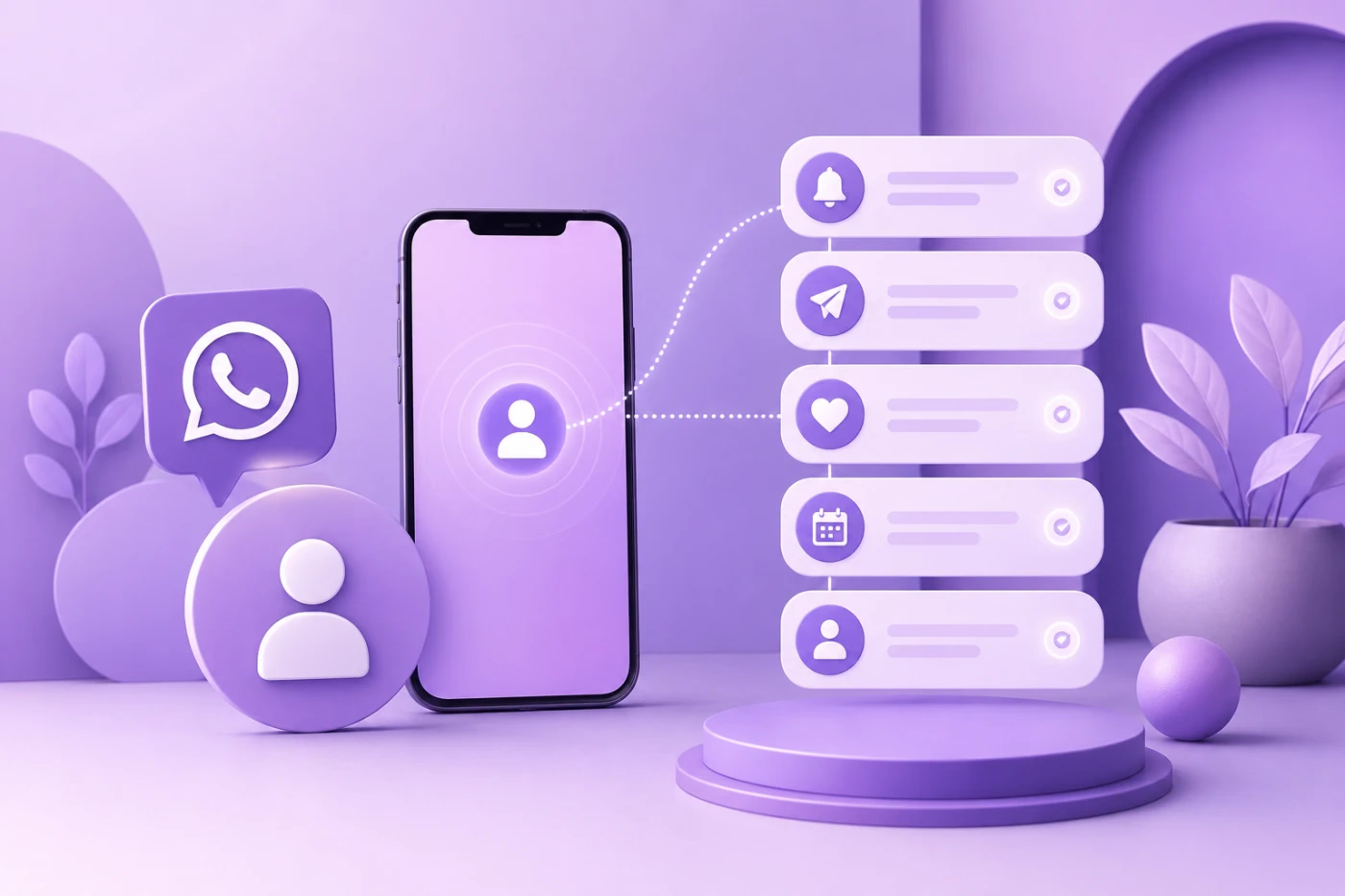
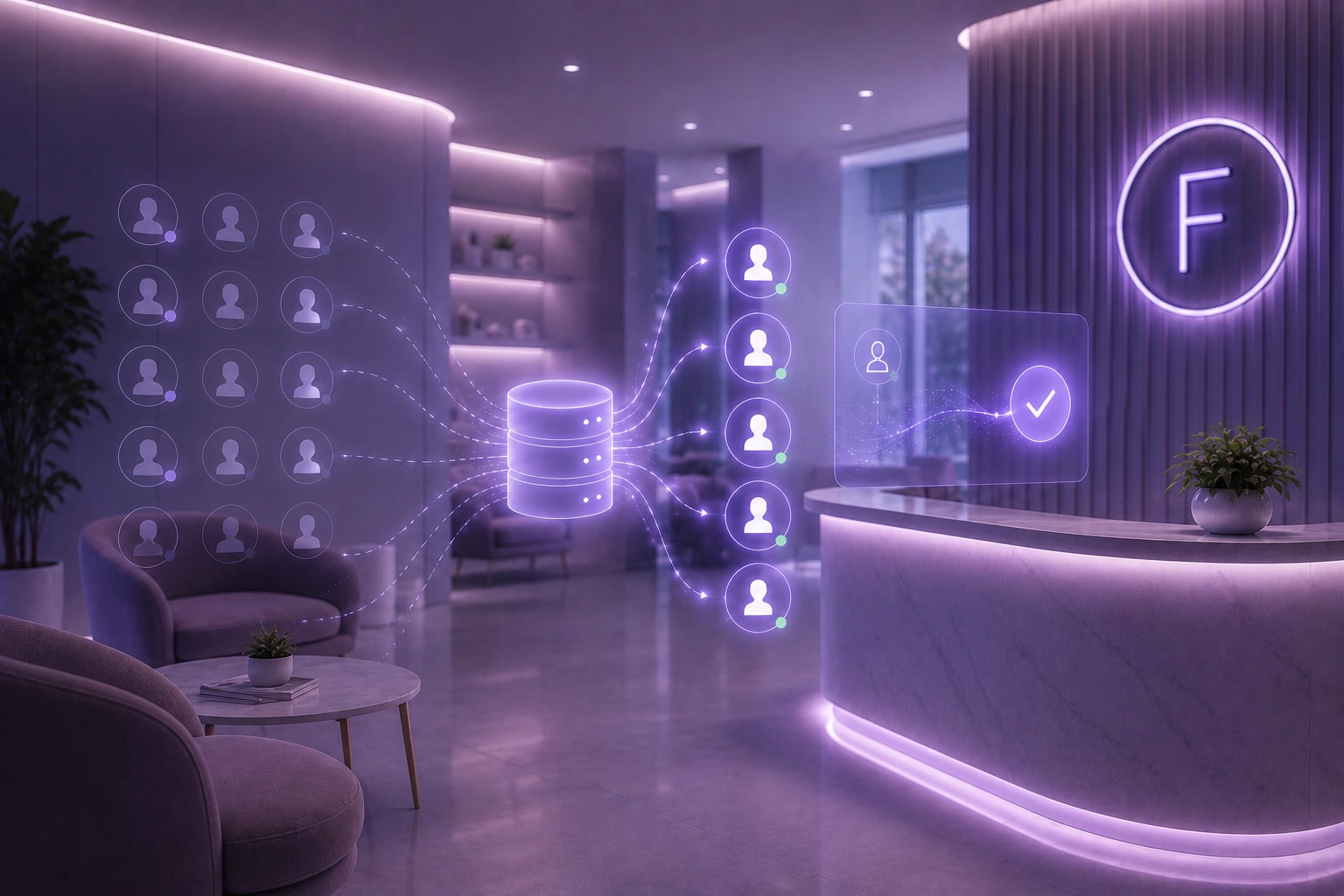
An AI receptionist resolves the execution layer of that problem. The conversational agent is trained with the clinic’s tone and information and operates continuously across WhatsApp, Instagram, messenger, and the website chat. The CRM records each patient’s expected return interval at discharge; the pipeline automatically moves them into the appropriate inactivity range when that interval expires; and the reactivation sequence fires with the message that fits their timeline and history. When a patient responds to rebook, the scheduling calendar works inside the same conversation, the appointment is confirmed without anyone on the team stepping in, and the follow-up reminders are already set.
The channel logic matters in the US context too. Meta’s platforms remain dominant in the medical aesthetics audience — Instagram in particular is where a large share of aesthetic patients follow clinics, discover new treatments, and expect to be able to reach a provider. An automated reactivation sequence that can reach across those surfaces, consistently and at the right moment for each patient, covers the ground that a front-desk team with a full appointment schedule realistically cannot.
The Numbers That Tell You Whether Your Timing Is Right
An aggregate reactivation rate hides exactly the information you need. Measured by inactivity cohort — zero to three months, three to six, six to twelve, and twelve-plus — it shows where your window is well-calibrated and where you’re contacting too late. If the zero-to-three range performs well below the three-to-six range, the expected interval you stored is too short and you’re writing before the patient feels the need. If performance drops sharply after month six, the clinic is detecting expirations with too much delay.
The second number that clarifies the picture is the show rate on appointments generated through reactivation. A patient who books from a win-back message and then no-shows is not a recovered patient, and a large gap between booking and attendance in a specific range signals that the message generated a polite response rather than a genuine decision. That distinction matters when you’re evaluating whether to expand or adjust the sequence.
Reactivation campaigns with well-structured, segmented sequences produce program reactivation rates of 12% to 20% across all inactive patients, according to industry benchmarks — a fraction that looks modest until you multiply it against the size of a typical clinic’s lapsed base. A practice with 600 patients who haven’t returned in over a year and a 12% reactivation rate means 72 rebooked appointments without spending a dollar on new patient acquisition.
If you want to see how many patients in your own base have already passed their reactivation window and what that volume represents in recoverable revenue, Floix Growth can run that analysis using your clinic’s actual numbers — not sector averages.
Frequently Asked Questions
How long should I wait before contacting a patient who hasn’t come back?
Two to four weeks after the end of their expected return interval for their treatment. For neurotoxin, that date falls around month four. For a routine dental checkup, around month seven. The wait is calculated from the procedure’s clinical cycle — not from a fixed administrative calendar date.
When is a patient officially considered inactive?
When they exceed the expected return interval for their treatment without rebooking. The twelve-month threshold many clinics use works as an accounting cutoff, but clinically a neurotoxin patient is already overdue at month five, and treating them the same as a patient absent for eighteen months produces predictably poor results.
Should I offer a discount in the first reactivation message?
In short-cycle ranges, avoid it. Offering a discount at the three-month mark trains your base to wait for a promotion before rebooking. A discount makes sense starting around six months of inactivity, where the patient’s decision inertia is higher and the incentive offsets a harder ask.
How many messages can you send before it becomes intrusive?
Three spaced contacts per range work well: one at the opening of the window, a follow-up seven to ten days later, and a low-commitment close at thirty days with an explicit opt-out available. After a third message with no response, the patient moves to the next inactivity range and waits for the following cycle.
Is it worth reactivating patients who have been gone for more than a year?
Yes, with adjusted expectations and a low-ask message. The primary return from that range is database clarity: knowing what percentage of your patient history is still reachable lets you calculate the true value of your new patient acquisition investment — and decide where to put the next dollar.
We diagnose your operation and show you exactly which module solves your bottleneck.