The Number That Never Shows Up in Your Month-End Report
At the end of every month you review collections, appointment volume, maybe cost per lead. There’s one figure that almost never makes it into that report, and it explains a large share of the result: how many of the patients who came through your practice in the last twenty-four months have already decided, without ever saying so, that they aren’t coming back. These are people who had a perfectly good experience, paid, walked out the door, and vanished from the calendar without leaving a trace.
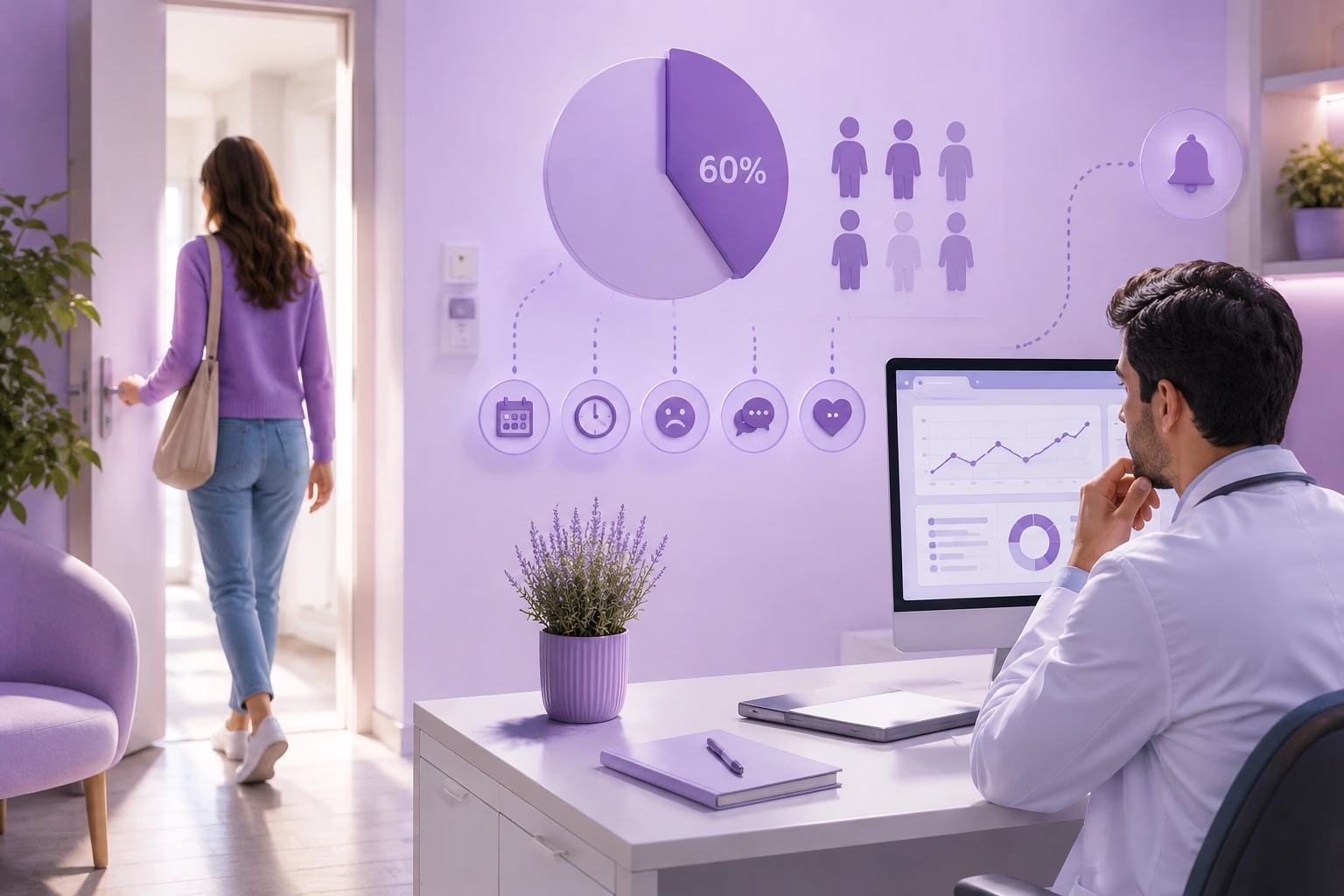
The industry data puts that leakage right around 60%, and it arrives there from three separate directions that converge on the same order of magnitude. The average five-year retention rate for new patients sits at just 43%, which leaves the remaining 57% out of the system. Medical practices lose roughly two-thirds of their first-time patients to a lack of follow-up and broken communication. And at practices auditing their historical base for the first time, recoverable inactive patients account for 40% to 60% of everyone on record. The aesthetic segment shows the same pattern in a different shape: even though 73% of med spa visits now come from repeat patients according to the American Med Spa Association’s State of the Industry reporting, average visit frequency runs at 3.2 appointments per year, well below the seven or eight that top-performing practices sustain. Each annual visit a patient skips can represent up to 30% of revenue the practice never sees.
What makes this problem so expensive is that it happens off the books. A subscription business knows the exact date of every cancellation and sometimes the stated reason, which means it can build a process around intervening. A practice has only a schedule that quietly stops showing a name, with no advance signal that would allow anyone to act in time, and that information gap makes it impossible to fix what actually needs fixing.
Silent churn in a medical or aesthetic practice describes the loss of patients who stop their treatment or follow-up care without canceling, complaining, or giving any explicit sign of dissatisfaction. It is measured by comparing each patient’s last-visit date against that individual’s own historical visit frequency, and it becomes visible only when a practice cross-references those two data points systematically and on a recurring basis.
It Ended With “Just Reach Out Whenever”
Price and competition account for far less of the decision not to return than most owners assume. The cause that shows up most consistently has to do with how the appointment closes: nobody gave the patient a specific date for the next step in their plan.
The mechanism is so routine it can pass for protocol. The patient finishes the session, the result looks good, the provider is satisfied, and the visit ends with an open-ended phrase along the lines of “come back whenever you need to” or “we should probably do a check-in at some point.” None of those sentences produces a concrete action, and all of them hand responsibility for returning to someone who at that exact moment feels great, which puts their urgency to act at precisely zero.
That urgency does not come back on its own. Life resumes, the treatment result normalizes until it becomes invisible to the person wearing it, and what felt like an obvious next step in the chair turns into something indefinitely postponable. Weeks later, the patient can’t clearly recall whether they were told they needed to come back or simply that they could if they felt like it.
A specific proposal — “does Tuesday the 12th at eleven work for your next session?” — produces a different outcome than an open intention like “we’ll call you to coordinate,” because it forces a decision while the result is still fresh and the patient’s willingness to commit is at its peak. Mercury Healthcare’s analysis quantifies the effect of that personalization: new patients who receive a personalized interaction are 35% more likely to be retained than patients who go through the same treatment without one.
What Eight Weeks of Silence Actually Cost
Between one visit and the next — four to twelve weeks for aesthetic treatments, three to twelve months in clinical contexts — the relevant question is what communication the patient receives from the practice. For most practices the honest answer amounts to nothing, aside from the occasional promotional blast that goes out to the entire list anyway.
That silence produces an effect that gets underestimated across the board, because patients read it as a signal about how much they matter outside the moment they’re about to pay. Even though that reading has nothing to do with anyone’s intention inside the practice, it’s the perception that ends up settling in.
The Rockefeller Corporation study on why customers leave a service provider, widely cited in retention literature, breaks the causes down this way: 1% die, 3% move away, 5% develop other business relationships, 9% are persuaded by a competitor, 14% leave because they’re dissatisfied with the product or service, and 68% leave because of a perceived attitude of indifference. Perceived indifference on its own outweighs price, competition, and dissatisfaction combined as a reason for defection.
Breaking through that invisibility calls for contact with clinical value, which is a different thing from the promotional messaging most practices send between sessions. A message five to seven days after a treatment asking how the result has settled. A post-procedure care reminder that lands at the exact moment the patient needs it. A short note about what comes next in their specific stage of the plan. None of this requires a dedicated marketing team. It requires that someone design the sequence once and that a system execute it for each patient at the right point in that patient’s individual cycle.
That kind of contact reads as a continuation of care and builds the perception that the practice is still invested in the outcome beyond the billable appointment, which is exactly what the second visit and the tenth are built on.
After Day 90, Winning a Patient Back Costs Almost as Much as Buying a New One
There’s a period after which reactivating a lapsed patient becomes exponentially harder. The threshold varies by treatment type and patient profile, but in behavioral analysis of medical and aesthetic practices the critical window shows up consistently between sixty and ninety days after the last visit.
Before that threshold the patient still holds the recent experience in memory, the barrier to returning is low, and a simple message is usually enough to trigger a rebooking. Past ninety days, the experience fades, perceived need drops, and the inertia of not going consolidates into the default state. Reversal remains possible, though at a markedly higher cost in outreach effort and, frequently, in the financial incentive required to move the patient at all.
The arithmetic of that delay is concrete. Average patient acquisition cost in 2026 runs about $370 across specialties and climbs to roughly $610 in cosmetic surgery, while reactivating a lapsed patient costs five to twenty-five times less. Companies have a 5% to 20% chance of converting a brand-new lead and a 20% to 40% chance of winning back a lost one. Despite that spread, only 30% of medical practices use effective win-back strategies at all.
The real obstacle is visibility. The data has always been there: any practice management system records each patient’s last-visit date. What’s missing is someone looking at that data every day with the right question, which is who is hitting sixty days without a booking and what gets done about it today.
An AI Receptionist Watching the Calendar When Nobody Else Is
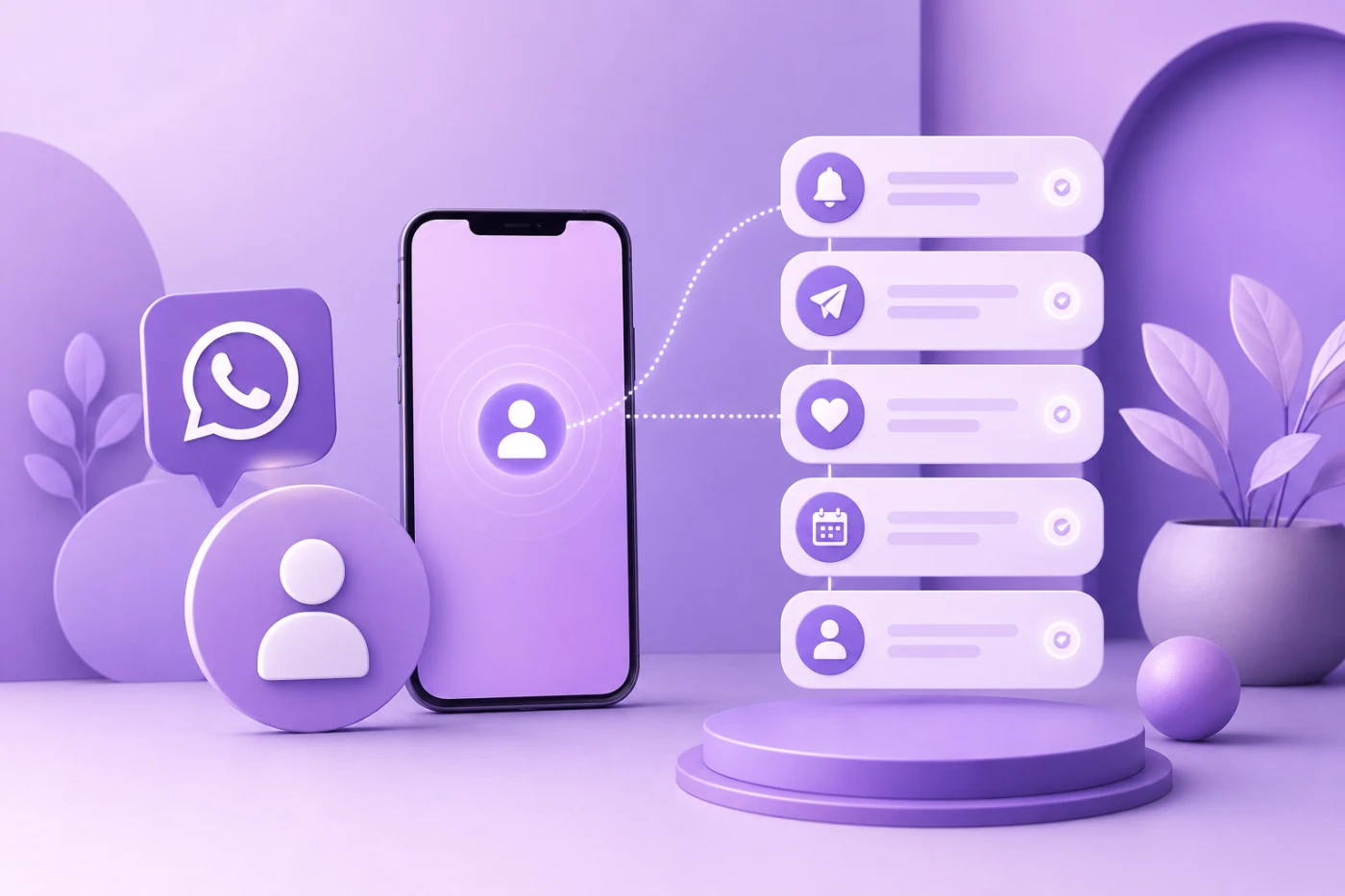
This is where an AI receptionist changes the operating math of a practice. It’s a conversational agent trained on your practice’s own tone and information, running around the clock across Instagram DMs, WhatsApp, and web chat, with a built-in CRM that logs, classifies, and segments every patient, a conversion pipeline with defined stages, and its own scheduling calendar that closes the appointment inside the same conversation without routing the patient to another tool or making them wait for a staff member to free up.
The channel choice tracks patient behavior rather than practice habit. In 2026, 93% of patients have opted in to receive texts from their providers, and 90% say text is their preferred way to hear from a practice, ahead of email at 59%, patient portals at 55%, and phone calls at 34%. Two-way messaging is what patients specifically want: 68% say they want to be able to ask a simple question or confirm and reschedule an appointment by text. Response rates follow the same hierarchy, with reminders drawing 52% response by text against 28% for email and 26% for phone. Consent architecture matters as much as the channel, so opt-in capture and documented consent belong in the setup from day one rather than bolted on later.
Detection is built on each patient’s individual visit history rather than generic thresholds applied to the whole list. The starting point is personal frequency: a patient who came in every thirty days and is now forty-five days out sends a very different signal than one who came in every ninety days and is now at a hundred.
On that logic the system runs three tiers. The first triggers around forty-five days of deviation from individual frequency and sends a light clinical check-in, a question about how the result is holding, which keeps the relationship open before inertia sets in. The second, between sixty and seventy-five days of deviation, launches a reactivation sequence built on that specific person’s history, so someone who completed three facial treatment sessions last year receives a different message than someone who came in once for a diagnostic consult. The third, past one hundred ten or one hundred twenty days, flags the patient as high risk of permanent loss and opens a recovery protocol with an incentive built on their particular history with the practice and a defined expiration, which performs far better than the blanket discount blasted to the entire database.
Layered on top of detection are automated appointment reminders that run without manual staff involvement. The effect is well documented: practices that deploy automated reminders cut no-shows by as much as 38%, and those combining reminders with pre-visit digital engagement report reductions between 25% and 40%. Patients confirm this in their own words, with 84% saying they’re more likely to attend an appointment after receiving a text reminder from their provider. Every no-show avoided is an appointment nobody has to rebook and a patient who doesn’t drift into the critical window unnoticed.
What makes this structure work is that nobody on staff has to open a spreadsheet or remember who came in when. Alerts arrive with the context already processed and the message drafted; the team approves or adjusts, and the system handles identification, copy, and delivery.
The Math on Recovering People Who Already Trusted You
A practice seeing two hundred new patients a month accumulates a base of roughly 4,800 records with at least one visit over two years. If 40% to 60% of that base is inactive, which is the usual range at practices that have never run the measurement, that’s between 1,900 and 2,900 patients reachable today. A well-configured multi-touch reactivation campaign typically re-engages 20% to 35% of inactive patients, putting the outcome somewhere between 380 and 1,000 recovered appointments with no additional advertising spend attached to any of them.
That volume beats almost any acquisition campaign the same practice could run on a comparable budget, and the effect on margin is disproportionate: a 5% increase in retention rate lifts profitability by 25% to 95%, per the Reichheld research MGMA cites in its own guidance on patient turnover. Repeat patients also spend 67% more than new ones, so every reactivation carries a higher average ticket than a first visit does.
Beyond cost there’s time. A new patient has to build trust from zero, work through the initial hesitation, compare options, and decide. A patient returning after a period of inactivity already walked that entire path with you, and the only thing missing was someone remembering them inside the window where coming back was still easy.
If you want to know how many inactive patients your practice has today and which window each of them falls into, at Floix Growth we can run that cross-reference with you against your own data. The starting point is the last-visit date on your actual patient base, not sector averages.
Frequently Asked Questions
How do I find out how many inactive patients my practice has right now?
Cross-reference two data points your practice management system already holds: every patient with at least one visit in the last twenty-four months, and their last appointment date. Anyone past ninety days with no booking and no documented discharge is a recoverable inactive patient. At practices that have never measured this, that group usually accounts for 40% to 60% of the historical base.
What’s the difference between an inactive patient and one who’s permanently gone?
A patient under twelve months of inactivity has a reasonable probability of reactivation with the right message at the right moment. Between twelve and twenty-four months the probability drops but stays positive if their prior history includes more than a single visit. Past twenty-four months with no intermediate contact, the effort starts to resemble new-patient acquisition.
Text, phone, or email for reaching lapsed patients?
Text leads clearly in the US market: SMS open rates run 95% to 98% against 15% to 25% for healthcare email lists, and 90% of texts are read within three minutes. Reminder response rates run 52% by text, 28% by email, and 26% by phone. Email works best as a backup for anyone who hasn’t replied within 48 to 72 hours.
Does the alert system need dedicated software, or can I build it with what I have?
It can be implemented at three levels. The most basic is a spreadsheet with last-visit dates and a days-inactive formula, which works right up until the manual process gets abandoned for lack of time. The intermediate level uses filters in your existing CRM to export lists by inactivity threshold. The optimal level fires alerts and drafts the message with no staff involvement beyond approval.
What reactivation rate is realistic in the first year?
Multi-touch reactivation campaigns typically re-engage 20% to 35% of inactive patients contacted. That figure rises when first contact lands before seventy-five days of inactivity and falls sharply past one hundred twenty days with no prior touch. After timing, the variable with the largest impact is how well the message is personalized to each patient’s history.
We diagnose your operation and show you exactly which module solves your bottleneck.