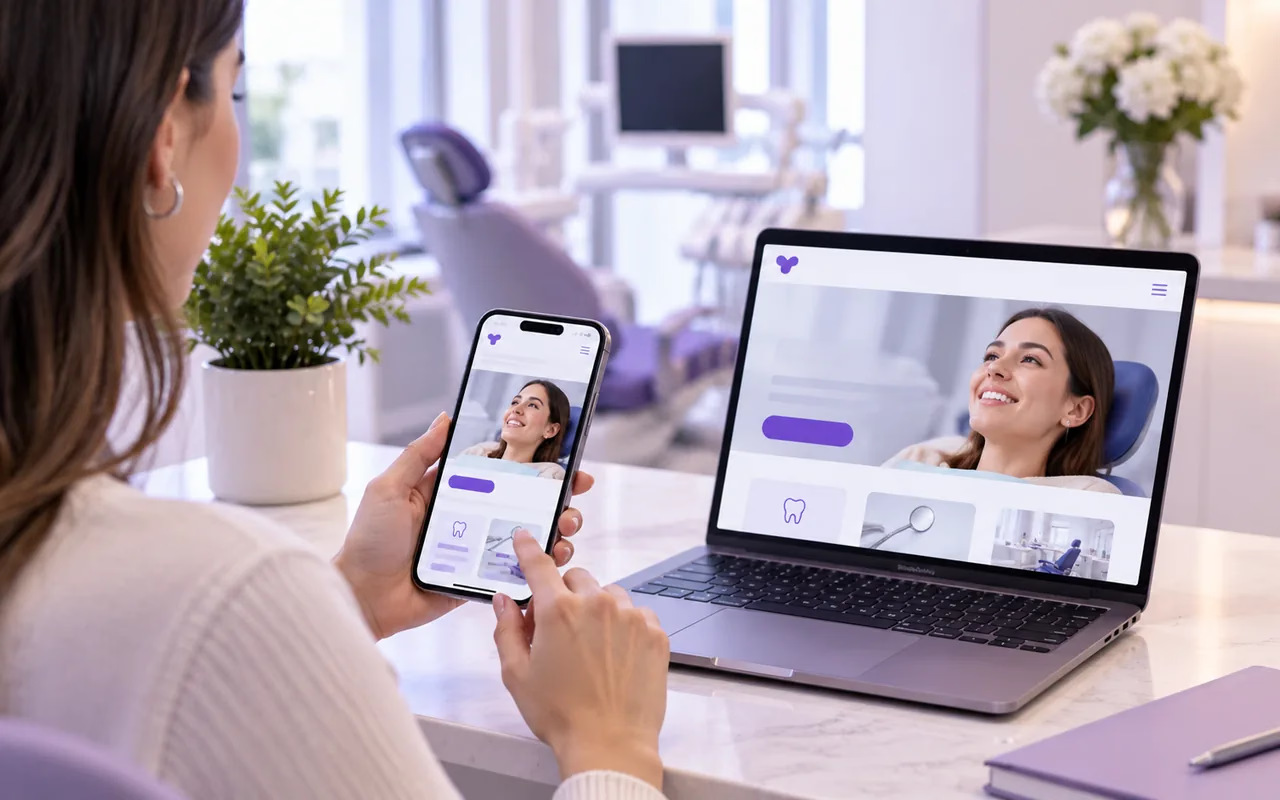
A bilingual Spanish/English site: why your clinic needs to speak to both search markets
A bilingual patient doesn't always search in the same language. If your site only exists in one, you're invisible in half their searches.

Quick answer
Many bilingual patients search in Spanish and English depending on the moment, not always in the same language. A site that only exists in one of the two simply doesn't show up, to Google, in half of those searches — no matter how well it's optimized in the language it does have.
Key takeaways
- A bilingual site isn't translating the same page twice — it's two real versions, each independently indexable and findable on Google.
- The technical "hreflang" tag is what tells Google which version to show each person based on their search language — without it, Google has to guess.
- A bilingual community doesn't pick one fixed search language: it shifts depending on the moment, the topic, or even who referred the clinic.
- A well-built bilingual site is also a trust signal for the patient: it directly communicates they'll be seen in whichever language they prefer.
In this article
One patient, two search languages
In a bilingual community, the search language isn’t fixed — it shifts depending on the moment. The same person might search “dentist near me” in English during work hours, and “dentista que hable español” that same evening, looking for something slightly different: not just any dentist, but one they can explain things to without effort.
A site that only exists in Spanish — or only in English — isn’t losing “a bit” of reach: it’s completely absent from every search in the other language, no matter how much effort went into optimizing the language it does have.
Why translating a single page isn’t enough
Adding an automatic translation widget to the footer doesn’t solve this — Google needs each language to be a real, complete, independently findable version, not an add-on to the main one. That means:
- Every page has its own version in each language, with its own URL.
- The content is written naturally in each language, not translated word for word.
- Google can find and index both versions independently.
The technical piece that connects them: hreflang
For Google to know which version to show each person, every page needs a technical tag called hreflang, which explicitly declares: “this same page also exists in this other language, here’s the link.”[1] Without that connection, Google might show someone searching in English the Spanish version — or simply not show either version with confidence.
It’s a purely technical piece, like structured data, invisible to the patient, but it’s the difference between two sites competing separately and two versions of one site working together.
More than SEO: it’s a trust signal
A well-built bilingual site isn’t just a reach tactic — it also tells the patient something directly before they even book that first appointment: you’ll be seen here in whichever language you prefer. For a clinic serving a bilingual community, that’s often the first real trust signal, even before the first phone call.
Your site in two languages with Floix Web
At Floix Web, a bilingual Spanish and English site is an add-on to any plan: $29, $39, or $49 a month, depending on the plan you choose. Both versions are written to read naturally in each language, and the technical SEO included in every plan covers indexing and the sitemap.
If your clinic serves a bilingual community, book a free call and we’ll look at it together, or check out the plans.
Frequently asked questions
01Is it enough to translate my site with an automated tool?
We don't recommend relying only on that. An unreviewed automatic translation can read as unnatural or outright confusing — and Google also evaluates the real quality of the content in each language, not just whether it exists.
02Do I need two separate domains, one per language?
No. The most common and recommended approach is one site with a language-based path (for example, yoursite.com/ for Spanish and yoursite.com/en/ for English), connected with the matching hreflang tag.
03Does this apply even if my clinic is in a mostly Spanish-speaking area?
Yes, it's still worth it — within the same bilingual family or community, it's common for different people to search in different languages, or for the same person to search in English at work and in Spanish at home.
References