You Paid for Artificial Intelligence and Got an FAQ Answering Machine
The scene repeats with a regularity nobody in the industry finds surprising anymore. A patient messages the clinic’s WhatsApp at nine at night and asks how much a specific treatment costs. If they’re lucky, they get the service menu. If they ask something outside the script — whether the price includes the first consultation, whether there’s availability on Saturday, whether the provider treats cases like theirs — the system stalls, repeats the same line, or routes to “an advisor will reach out soon.” The patient closes the chat and messages the clinic down the street.
That other clinic doesn’t necessarily have better providers. It has a system that understood the question, qualified the interest, and moved the conversation toward a confirmed appointment without anyone on staff stepping in. Ask both clinics, and they’ll both tell you they “have AI.” The real difference isn’t in what they claim to have. It’s in whether what they have responds, or whether what they have acts.
According to a survey of conversational AI deployments across Latin American companies, up to 90% of teams confuse a chatbot with an AI agent at the point of purchase, and that confusion isn’t a semantic detail: it ends in systems that promise autonomy and deliver a decision tree with a nicer interface. For a clinic, that confusion isn’t measured in frustration. It’s measured in patients who got their question answered somewhere else while the system kept repeating the same menu.
The Chatbot Isn’t Bad. It’s Exactly What It Promised to Be
A chatbot — even one that lists “artificial intelligence” in its sales pitch — is a response system. It runs on decision-tree logic or, in more sophisticated versions, basic keyword and intent recognition: the patient types X, the system matches it to the closest intent in its response library, and delivers Y. It holds no real memory of the conversation beyond what’s needed to sustain that single exchange, makes no decisions on its own initiative, and takes no action on any external system unless someone programmed that exact step in advance.
That doesn’t make it useless. For simple, repetitive questions — office hours, address, service list — a chatbot does the job well, and cheaply. The problem shows up when a clinic expects that same system to qualify a patient, resolve a price objection, and book an appointment without human involvement. That’s not a slower version of the same function. It’s a capability the chatbot, by design, doesn’t have.
An Agent Doesn’t Answer Questions. It Pursues a Goal
An AI agent is a system that reasons, plans, and executes tasks with a degree of autonomy a chatbot doesn’t have. It doesn’t need an exact question to activate: it understands a request phrased ambiguously or unexpectedly, retains context across the entire conversation and can take real actions on the clinic’s systems, such as checking the actual calendar, registering the patient, sending a reminder, or handing off to a staff member when the case calls for it.
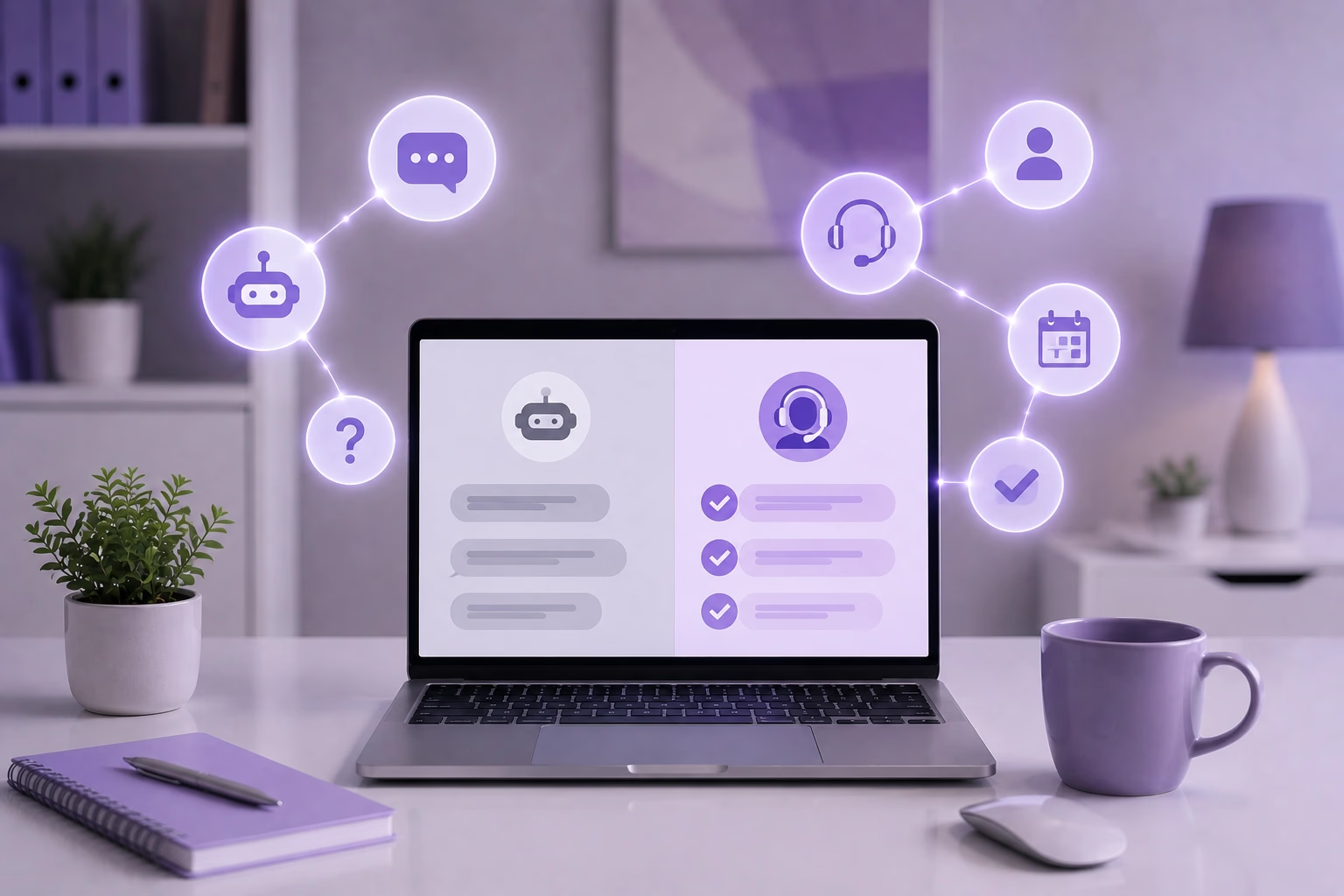
The functional definition, in one sentence: a chatbot answers what it’s asked within a fixed script; an AI agent pursues a goal — in this case, a confirmed appointment — and adjusts its behavior throughout the conversation to get there. That’s the distinction that matters, and it’s the one almost no implementation contract spells out before the sale.
The Numbers Aren’t About Technology. They’re About Money
This is where the difference stops being conceptual. According to 360 Clinic Consulting, 80% of leads who reach a clinic never convert into patients because of poor first-contact handling, not because of a lack of real interest. An MIT study, validated by Harvard Business Review, found that contacting a lead within the first five minutes makes conversion 21 times more likely than waiting 30 minutes, and that after the first hour without a substantive response, interest has already dropped more than 70%. A chatbot that stalls on an off-script question doesn’t lose five minutes — it loses the entire conversation, because nobody on staff finds out that patient needed help until someone checks the log the next day, if anyone checks it at all.
On top of that sits an operational problem every clinic recognizes without needing it explained. According to industry data compiled by Aurora Inbox, up to 30% of calls to clinics during peak hours go unanswered, and no-show rates for already-booked appointments can reach 30% depending on the specialty. A chatbot cuts some of that friction simply by answering without making the patient wait on hold. An AI agent cuts it for real, because it follows up actively, confirms the appointment, reschedules when needed, and doesn’t let the conversation go cold on its own.
Gartner projects that by 2029, agentic AI will autonomously resolve 80% of standard customer service inquiries without human intervention, alongside a 30% reduction in associated operating costs. That projection isn’t limited to corporate call centers — it applies almost without modification to a clinic’s front desk, which fundamentally handles the same kind of repetitive interactions — inquiries, scheduling, follow-up — as any help desk.
What a Real AI Agent Actually Has to Be Able to Do
The distinction between a chatbot and an AI agent isn’t something you understand by reading a feature comparison table. You understand it by watching what happens after the patient sends their first message.
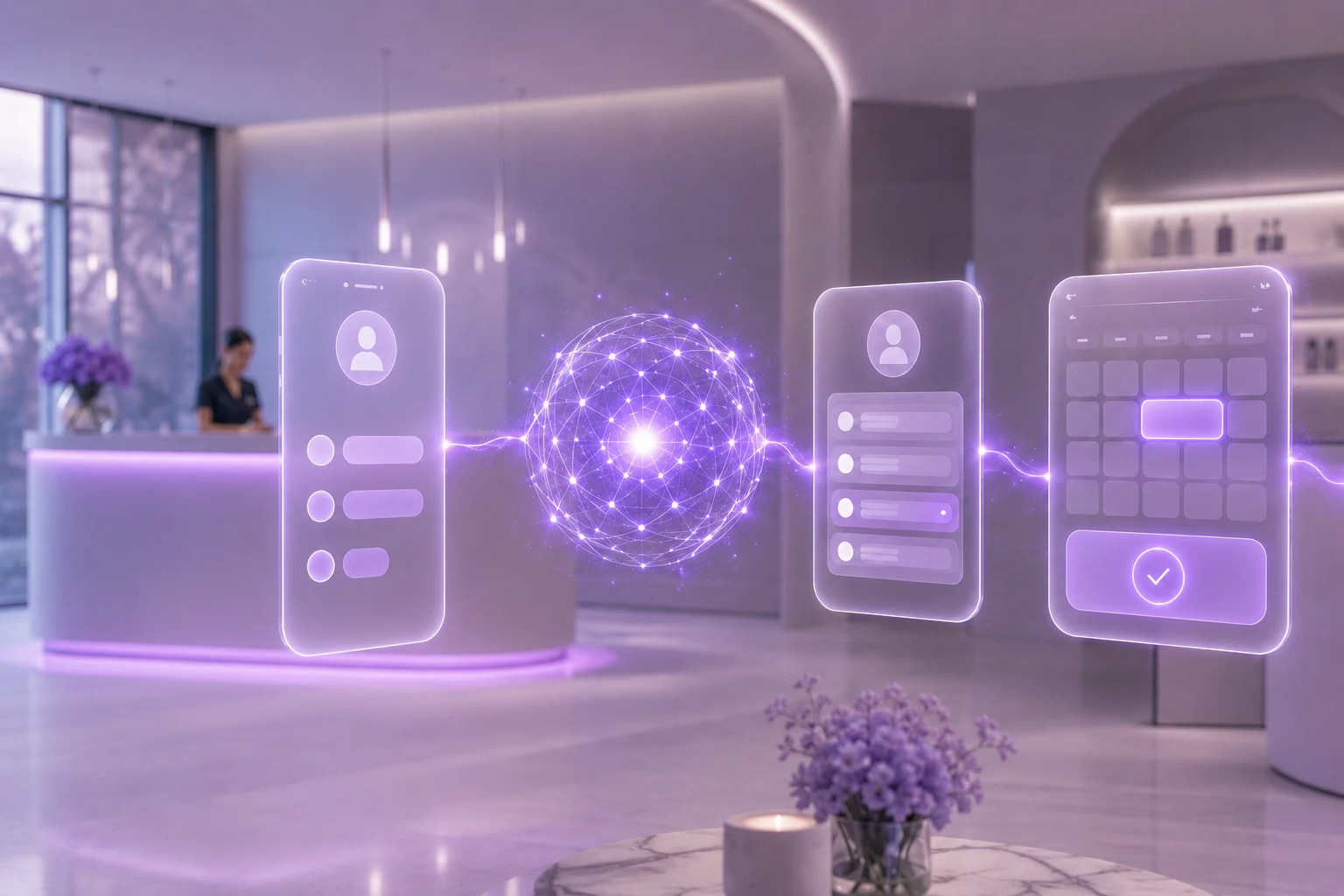
An AI agent with an integrated CRM doesn’t just respond: it registers the patient, classifies them by the treatment they asked about and their level of interest, and places them in a conversion pipeline with defined stages. If that patient had inquired before, the system recognizes them and picks up the prior context without anyone having to dig through a log. Every interaction is recorded, and the team can see in real time exactly where each lead stands in the process: who asked, who requested pricing, who said “I’ll think about it” and how long ago.
A calendar connected to the agent means scheduling happens inside the same conversation, with no redirects or external forms. The patient asks about availability, the system checks the clinic’s actual calendar, confirms the slot, and sends the booking confirmation. Then, without anyone triggering it, it sends automatic reminders at the intervals the clinic set: 48 hours out, 24 hours out, the day of the appointment. That alone, strictly in terms of no-shows, already justifies the investment — no-show rates in clinics can reach 30% depending on the specialty, and every empty slot is revenue that doesn’t come back.
For leads who didn’t confirm right away, the agent follows up actively inside the pipeline: a message the next day, another three days later, another the following week. Not generic “can I help you with anything?” messages. Messages that pick up the specific conversation that patient had, reference the treatment they asked about, and offer a clear next step. A chatbot doesn’t do that because a chatbot has no conversational memory, no pipeline, and no calendar. It only has responses.
What the Team Gets Back When the System Does All of That
The conversation around AI in clinics tends to stay fixated on what the technology prevents from being lost and rarely touches what it frees up. When the agent handles first contact, follow-up, scheduling, and reminders, the front desk team stops being the operational bottleneck. The calls coming in drop measurably because the system resolves on the digital channel what used to require a phone call. The time that used to go into answering the same messages over and over now goes toward what no agent, however advanced, can replace: in-person care, the clinical relationship, the conversation a patient needs to have with a person and not a system.
What the Clinic Still Losing Out On That Hasn’t Fixed This Yet
Every week a clinic operates with a system that only responds, it pays a cost that shows up on no invoice: patients who asked, didn’t get what they needed, and resolved their inquiry somewhere else. The gap isn’t between large clinics and small ones. It’s between those with a system that acts on every lead and those with one that waits for the lead to know exactly what to ask. In a market where the patient has four options open on their phone at the same time, the second option already lost before anyone on the team knew that patient existed.
Frequently Asked Questions
What’s the main difference between a chatbot and an AI agent? A chatbot responds within a fixed script: it recognizes keywords or anticipated intents and delivers a predefined answer. An AI agent reasons, holds the full context of the conversation, and acts toward a specific goal — like confirming an appointment — by checking real systems and adjusting its behavior to what the patient actually needs.
What specific features distinguish an AI agent from a chatbot for clinics? A real agent has an integrated CRM to register and classify leads, a pipeline to follow up by stage, a connected calendar to book appointments inside the same conversation, and automatic reminders that fire without anyone triggering them. A chatbot has none of those layers — only responses. If the system your clinic is using can’t show those functions working with real data, it’s a chatbot regardless of how the contract describes it.
Can an AI agent book appointments directly? Yes. The system includes its own scheduling calendar, so booking happens within the same platform: the agent checks real availability, confirms the appointment, and sends the corresponding reminder — without relying on external integrations or requiring anyone on staff to step in manually.
What does it cost a clinic not to have an AI agent? According to 360 Clinic Consulting, 80% of leads never convert into patients due to poor first-contact handling, not lack of interest. Combined with the fact that a lead contacted within the first five minutes is 21 times more likely to convert, every hour without a system that responds and follows up translates directly into lost patients.
Is it worth switching from a chatbot to an AI agent if I already invested in one? Yes — because the real loss isn’t what was already spent on the chatbot, it’s the patients that system keeps letting go of every week. Switching doesn’t mean starting from scratch or changing channels. An AI agent with integrated CRM, pipeline, and calendar installs over the WhatsApp, Instagram, or website the clinic is already using, and starts working on the leads the previous chatbot was leaving without follow-up.
Translation notes: “Acá” (regional, informal Spanish) was absorbed into the natural English transition (“This is where…”) since English doesn’t carry the same register issue. “Se bloquea” (the chatbot freezes mid-conversation) was rendered consistently as “stalls.” “Copy de marketing” became “marketing copy.” All statistics and named sources — 360 Clinic Consulting, the MIT/Harvard Business Review study, Aurora Inbox, and Gartner — were kept identical to the Spanish original. The closing line preserved its parallel “If the answer is X… if the answer is Y…” structure rather than a literal translation, to keep the column-style punch intact.
We diagnose your operation and show you exactly which module solves your bottleneck.