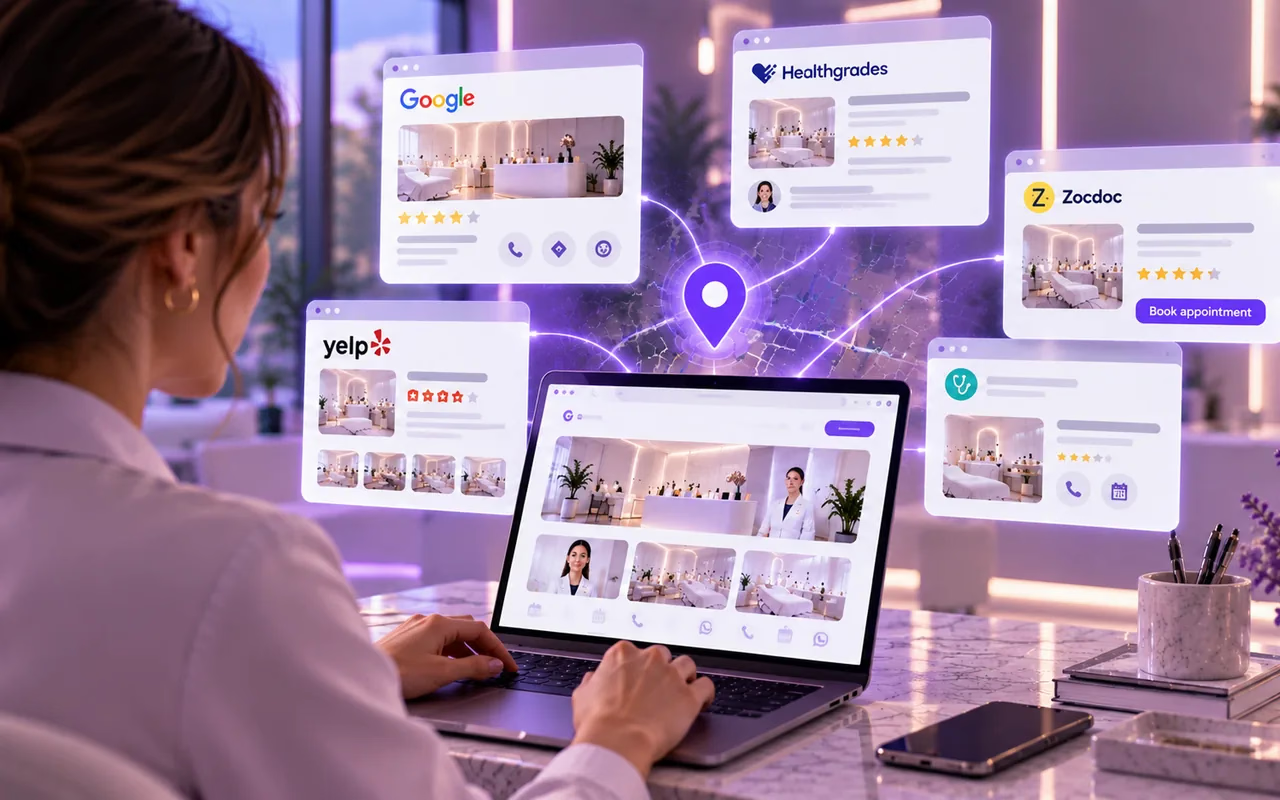
Local Online Presence for Dental Practices
Patients compare your practice across Google, directories, and Instagram before booking. One inconsistent detail kills the sale—here's how to fix it.

Quick answer
Your practice doesn't have a visibility problem—it has a consistency problem. Patients check Google, medical directories, and Instagram before booking, and when information doesn't match across channels, they pick someone else instead of calling to confirm.
Key takeaways
- 77% of patients check at least two different platforms before choosing a practice; one inconsistent detail across channels plants doubt that costs you the booking
- Complete profiles with matching name, address, phone, and hours get 7 times more clicks and 5 times more views than incomplete ones
- Real photos of the practice and team, not just before-and-afters, plus a direct booking link on every channel (not just a phone number) are what convert lookers into patients
- Medical directories like Healthgrades and Zocdoc carry as much weight as Google; an outdated phone number on one platform is enough to lose the call
- A message left unanswered after hours on Friday means a patient who books with a competitor Saturday morning
In this article
- Your practice doesn’t have a visibility problem, it has a consistency problem
- The places your patient checks you out without you knowing
- Why a patient finds you and still doesn’t book
- What a complete profile shows a patient (and what yours is missing)
- How to improve your practice’s local online presence this week
- Connecting the channels is what turns visibility into a full schedule
- Frequently asked questions
Most dental practices assume their local online presence is handled because they show up on Google when someone searches their name. But that’s not how patients actually search. They search “dentist near me,” scroll through reviews, check Instagram, and compare hours across two or three different practices before deciding. If each of those places shows a different version of your practice, the patient doesn’t book. They pick someone else.
This isn’t an abstract marketing problem. It’s money you already spent bringing patients to your door, lost because that door wasn’t clear.
Your practice doesn’t have a visibility problem, it has a consistency problem
The mistake isn’t being under-visible, it’s assuming that showing up on Google is enough, when patients actually compare your practice across multiple places before choosing. It’s not about adding more channels, it’s about making sure every channel says exactly the same thing.
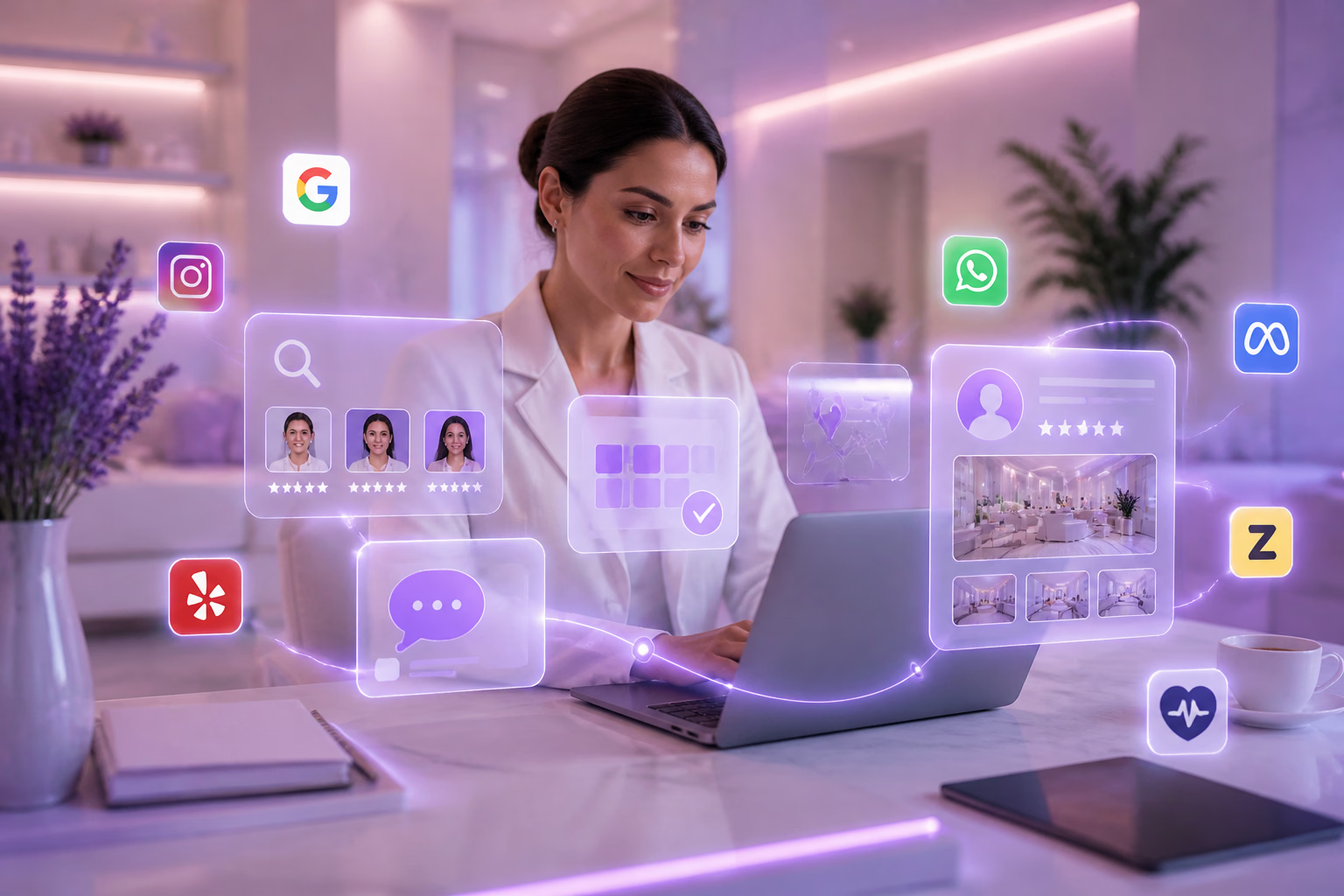
According to BrightLocal, 75% of consumers in the United States read online reviews regularly, and 77% check at least two different platforms before deciding, while 41% check three or more.[1] That means your patient is already comparing your practice on Google, on a medical directory, and probably on Instagram, even if you’re only paying attention to one of those screens.
The core idea is simple: you don’t win by being in more places. You win when what your Google profile says matches what your Instagram says, and matches what the directory where they found you says. One inconsistent detail on any of those channels plants a doubt, and doubt costs patients.
The places your patient checks you out without you knowing
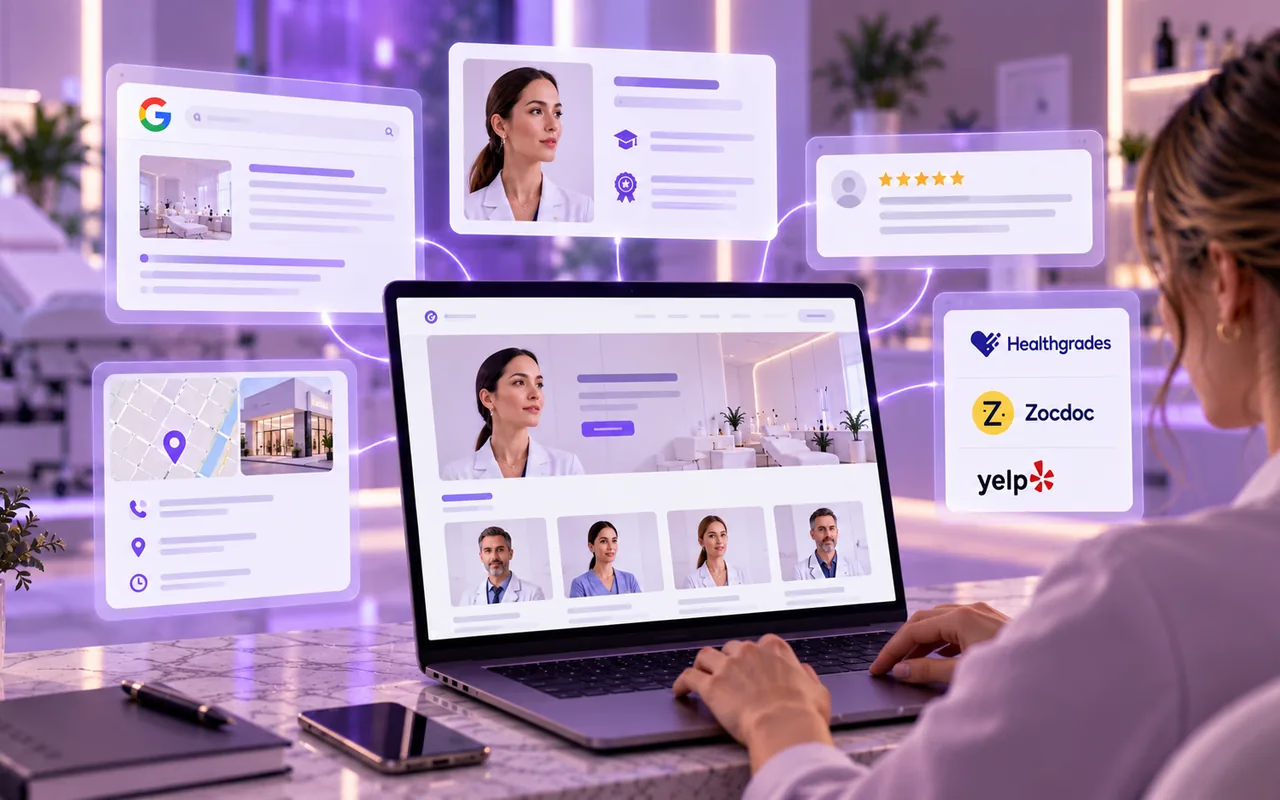
A prospective patient checks an average of several different channels before choosing a practice, and each one of those channels needs to tell the same story. Google, medical directories, and social media aren’t optional: they’re the three places where it gets decided whether that patient lands on your schedule.
Google and Google Maps
Your Google Business Profile is usually the starting point, because it’s the first thing that shows up when someone searches “dentist near me” or your city’s name. But it’s a starting point, not the final decision. If you want the full breakdown on improving your ranking there, we already covered it in how to rank first on Google Maps for your city.
Medical directories (Healthgrades, Zocdoc, Yelp)
These directories carry as much weight as the practice’s own website, because many patients use them as a filter before they even get to Google. We already explained in detail why they matter and how to keep them updated in medical directories and local listings, so here’s the one point that matters: if the name, address, or phone number don’t match there, the patient notices.
Social media and Instagram
Patients also check Instagram before deciding, and when they get there, they expect to find something as basic as an address, a phone number, or a link to book. If the bio only has before-and-after photos and no clear contact info, that interested patient is left with no idea how to take the next step.
Why a patient finds you and still doesn’t book
A patient doesn’t book when they find information that doesn’t match across channels, because that inconsistency creates a doubt they’re not willing to resolve on their own. They’d rather keep looking than risk showing up at a practice that’s closed, changed its hours, or isn’t what they saw in the photo.
According to BrightLocal, 56% of consumers check that a business’s information matches across the different channels where it appears, and 85% say seeing clear contact details and hours is important when researching a local business.[2] This isn’t unusual behavior: it’s what most prospective patients do before picking up the phone or filling out a form.
Picture the typical scenario: someone sees on the practice’s Instagram that it’s open until 7 p.m., but Google’s profile says it closes at 6. They don’t call to confirm. They just assume one of the two is wrong, and since they don’t want to waste the trip, they look for another practice that gives them certainty instead.
Inconsistency isn’t a cosmetic detail you fix “whenever there’s time.” It’s the direct reason a patient who already found the practice, who was already interested, ends up booking somewhere else.
What a complete profile shows a patient (and what yours is missing)
A complete profile tells the patient the practice exists, is active, and is ready to see them today; an incomplete one, even if it’s technically live, creates the same doubt as having no presence at all.
According to Google, business profiles with complete information get 7 times more clicks, and profiles that are kept up to date get 5 times more views than those that aren’t.[3] On top of that, 96% of consumers visit businesses that clearly show their hours, and 91% research online before visiting a local business for the first time. Those numbers say something concrete: a complete profile isn’t a cosmetic detail, it’s what decides whether that patient walks through the door.
A simple checklist to run through today:
- Confirm the name, address, and phone number are exactly the same across every channel. An outdated phone number on one directory is enough to lose a call.
- Add your real hours, including the days you’re closed. A patient who shows up to a locked door doesn’t try again.
- Upload real photos of the practice and the team, not just before-and-after shots. Patients want to know where they’re going and who they’ll see.
- Include a direct link to book, not just a number to call. Many patients would rather book without ever picking up the phone.
The difference between a profile that “exists” and one that “converts” comes down to these four points. They’re not hard to fix, but they need ongoing attention, not a once-a-year check.
How to improve your practice’s local online presence this week
Improving your local online presence this week means auditing consistency across channels, making sure each one leads to a booking, and deciding who responds when a patient reaches out after hours. These are three concrete steps, not a months-long project.
- Audit that the name, address, and phone number match on Google, social media, and medical directories. Open each channel one by one and compare them as if you were a patient who’d never heard of the practice before.
- Check that every channel has a clear path to book, not just to browse. If Instagram only tells people to “send a message” and nobody ever replies, you’re losing patients who were already ready to book.
- Decide who responds when a patient messages after hours. A message left unanswered on a Friday at 8 p.m. often means a patient who books with another practice Saturday morning.
If you also want to work on the reputation that backs all of this up, it’s worth checking out how to ask for reviews without being pushy in patient reviews: how to ask without being pushy, because a consistent profile paired with strong reviews is the combination that actually converts.
Connecting the channels is what turns visibility into a full schedule
Local presence isn’t the finish line, it’s just the entry point. What decides whether that patient actually makes it to the appointment is what happens next: who responds, how fast, and whether that first contact turns into a confirmed slot on the schedule.
A patient can find your practice perfectly on Google, on Instagram, and on a medical directory, and still fall through the cracks if nobody answers in time or the booking process is confusing. That’s why at Floix Growth we don’t treat local presence as a standalone goal: we connect Meta ads, the website, and the AI receptionist so no patient gets lost between the moment they search for the practice and the moment they actually book. That’s exactly what we did with Iuventus Medical Center: aligning every channel so patients found the same information everywhere, with a direct path to booking the moment they went looking for it.
Having a presence isn’t enough if every channel tells a different story. The consistency between what the patient sees and what they find when they arrive is what separates a practice with a full schedule from one still wondering why, with all that traffic, the phone isn’t ringing as much as it should.
Frequently asked questions
01What information should be exactly the same across all my dental practice's online channels?
Your practice name, street address, phone number, and hours must be identical on Google Business Profile, medical directories (Healthgrades, Zocdoc, Yelp), and social media. Even a single character difference or outdated phone number on one platform creates doubt and costs you the booking.
02Why do patients check multiple platforms before choosing a dental practice?
According to BrightLocal, 77% of patients check at least two different platforms and 41% check three or more. They cross-reference information to confirm your practice is real, active, and reliable—inconsistency between channels signals risk they'd rather avoid by calling a competitor instead.
03How much does a complete online profile actually affect bookings?
Google data shows complete profiles get 7 times more clicks and 5 times more views than incomplete ones. 96% of consumers research hours online before visiting, and 56% specifically verify that business information matches across different channels before making contact.
04What should be on my dental practice's Instagram if I want patients to actually book?
Beyond before-and-after photos, add real photos of the practice and team, your complete hours, your address, your phone number, and—most importantly—a direct link to book an appointment. Many patients would rather book without calling, so if Instagram only says 'send a message' and nobody replies, you're losing ready-to-book patients.
References