Medical directories and local citations: why Healthgrades, Yelp, and Zocdoc matter as much as your site
Google doesn't just trust what your site says — it checks that information against every directory where your clinic is listed. An outdated address on Yelp can cost you the top spot.
Quick answer
A local citation (or NAP: name, address, phone) is any mention of your clinic on a directory like Healthgrades, Yelp, or Zocdoc. Google compares those mentions against your own site and your Google Business Profile — the more exactly they match, the more confident it is that your clinic is real, active, and at that address.
Key takeaways
- A medical directory (Healthgrades, Zocdoc) or a general one (Yelp) acts, for Google, as a second source confirming your clinic exists and is still at the same address.
- Keeping your name, address, and phone number consistent across every directory and your own site matters more than being listed everywhere possible.
- An outdated directory listing (an address from a past move, an old phone number) doesn't just confuse patients — it also makes Google less sure which version of your clinic is the real one.
- You don't need dozens of directories: the 3 or 4 most relevant to your specialty, kept complete and consistent, are enough.
In this article
Your site isn’t the only source Google checks
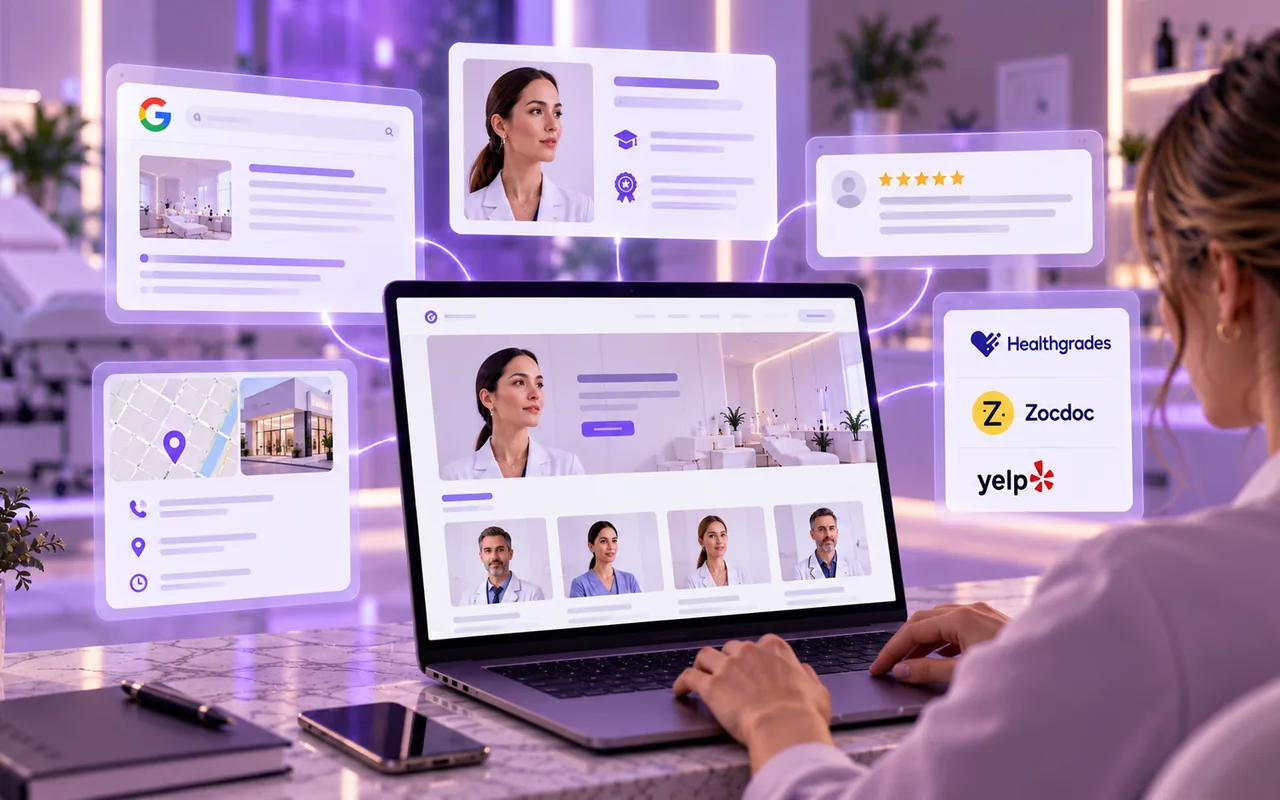
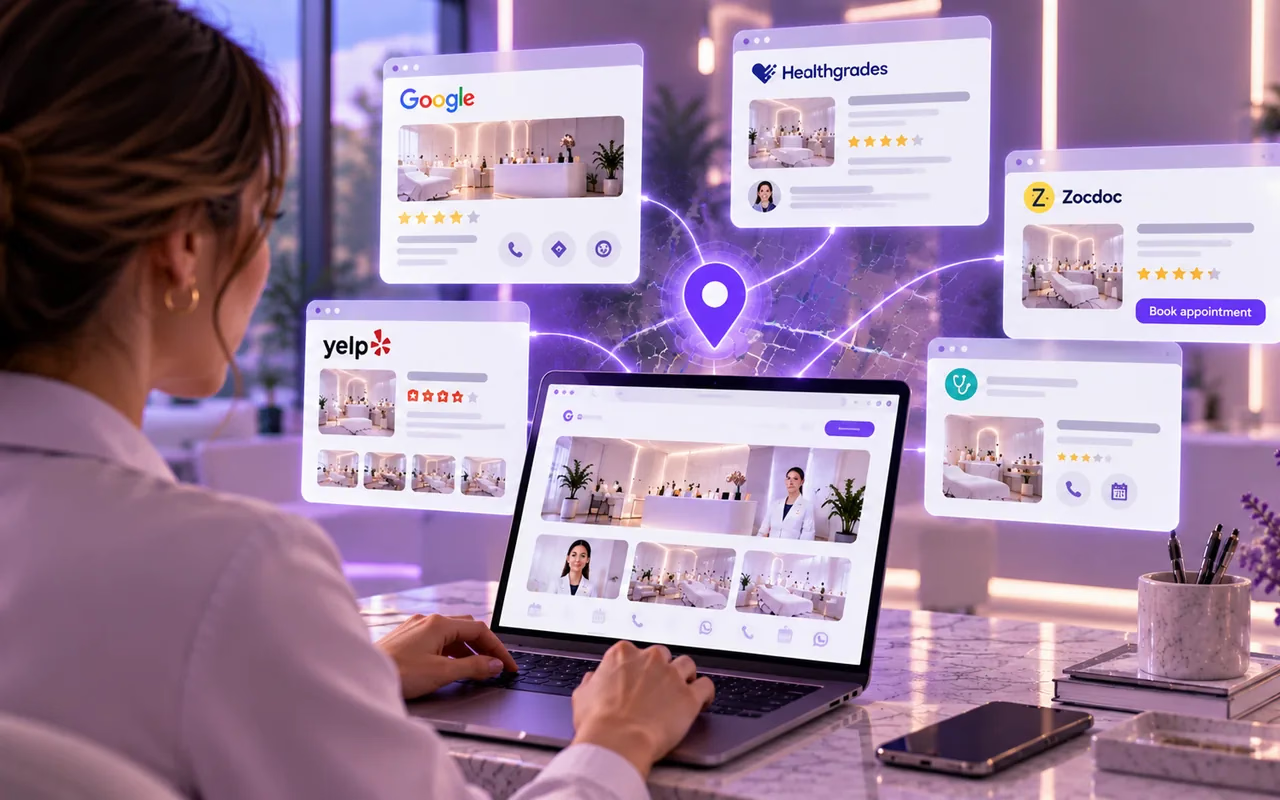
When someone searches for a dentist or an aesthetic clinic in their city, Google doesn’t just look at your own site — it also compares that information against every place your clinic is already mentioned: Healthgrades, Zocdoc, Yelp, insurance directories, local chambers of commerce. Each of these mentions is called a local citation, and together they act as a kind of second opinion Google uses to decide how much to trust the data on your own site.
This matters even more for a clinic than for most businesses: specialized medical directories (Healthgrades, Zocdoc) tend to carry their own trust weight within the healthcare space, independent of what your site says. And in healthcare, Google looks at trust especially closely, as we explain in E-E-A-T for healthcare websites.
What Google is actually comparing: NAP
NAP (Name, Address, Phone) is the standard all of these citations get reduced to. It doesn’t matter if your site says “Dr. González — Dental Office” and Yelp says “González Dental Office, Dr. María González” — a person obviously reads that as the same clinic, but a system comparing text automatically treats any difference as a reason for doubt.
| Data point | Why a mismatch matters |
|---|---|
| Name | A variation (with or without “Dr.,” full name or not) can read as two separate businesses |
| Address | A different street abbreviation, a missing suite number, an old address left over from before a move |
| Phone | An old number no longer in use, or a different number on each directory |
The more exactly these three match everywhere, the more confident Google is that the clinic is real, active, and exactly where it says it is.
More relevance, not more quantity
The most common mistake isn’t having too few directories — it’s having many, poorly maintained ones. An abandoned listing from five years ago, with an old address, does more harm than not being listed there at all. The real priority is:
- Google Business Profile, always the primary source. Keep it complete, with category, real hours, and photos (we cover how in our guide to local SEO on Google Maps).[1]
- Two or three directories that are genuinely relevant to your specialty (Healthgrades or Zocdoc for healthcare, whichever fits your specific field).
- One general-purpose directory like Yelp, since it’s still where a lot of people check reviews before deciding.
With just those, kept complete and saying exactly the same thing as your site, that’s enough — there’s no need to chase being listed in dozens of directories nobody actually checks.
How to check yours today
Search your clinic’s name on Google and note which directories show up in the top results. Open each one and compare name, address, and phone against your own site, letter by letter. Any difference you find — however small it seems — is worth fixing.
What Floix Web does (and doesn’t do)
Floix Web doesn’t manage directories, local citations, or your Google Business Profile. What we do take care of is the source all those listings get compared against: your own site, with a consistent name, address, and phone number. On the Professional and Authority plans, that data is also included as structured data so Google understands your site better.
If you want your site to be that clear reference point, book a free call or review the plans.
Frequently asked questions
01Which directories should my clinic be listed on, at minimum?
Google Business Profile always comes first. After that, whichever are most relevant to your specialty: Healthgrades and Zocdoc for healthcare generally, Yelp as a general-purpose directory, and any directory specific to your field (a dental-specific one if you are a dentist, for example).
02What should I do if I find an old address on a directory?
Fix it as soon as you find it. Most directories let you claim and edit your own listing for free — leaving it outdated is, in practice, telling Google you're not sure of your own address.
03Does this replace having a complete Google Business Profile?
No. Google Business Profile is the primary source; directories reinforce that same information from elsewhere. One without the other leaves the job half done.
References