An Empty Appointment Slot Is Not an Accident. It’s a Design Decision
The average no-show rate in medical and aesthetic clinics across Latin America hovers between 20% and 30% of scheduled appointments. In the United States, the American Medical Association estimates that no-show patients cost the healthcare system around $150 billion annually. At the level of an individual clinic running 15 appointments a day, that percentage translates to 3 empty chairs per day — each one carrying an opportunity cost that never shows up on a P&L but is felt at the end of every month.
What does show up in the numbers — when you look at them honestly — is this: most of those absences were preventable. Not because patients are irresponsible, but because the system didn’t do enough to keep the commitment alive between the moment of booking and the moment of the appointment. There’s a gap of days or weeks between those two points, and in that space things happen: life interrupts, intention cools, and nobody remembers what felt urgent ten days ago.
The most common mistake clinics make is treating the reminder as an administrative formality. A generic message goes out the day before, no response requested, task considered done. That approach has understandable operational logic — it requires minimal effort — but it completely ignores how human commitment actually works.
What Separates a Reminder from a Confirmation
A reminder says: “you have an appointment tomorrow.” A confirmation says: “you have an appointment tomorrow — are you coming?” The grammatical difference is minimal. The behavioral difference is not.
When you ask for an active response, you trigger what behavioral psychology calls the declared commitment effect. A study published in the Journal of Consumer Psychology found that patients who explicitly confirm an appointment show up at rates 25% to 35% higher than those who simply receive a passive notification. Not because they’re more responsible, but because saying “yes, I’ll be there” creates a psychological obligation that didn’t exist before they said it.
This isn’t theory. In the clinics where we’ve implemented this sequence, patients who respond to the 48-hour confirmation have a show-up rate of 91%. Those who don’t respond to any message: 58%.
That gap — 33 percentage points — is where the opportunity lives.
The Four-Step Sequence That Closes That Gap
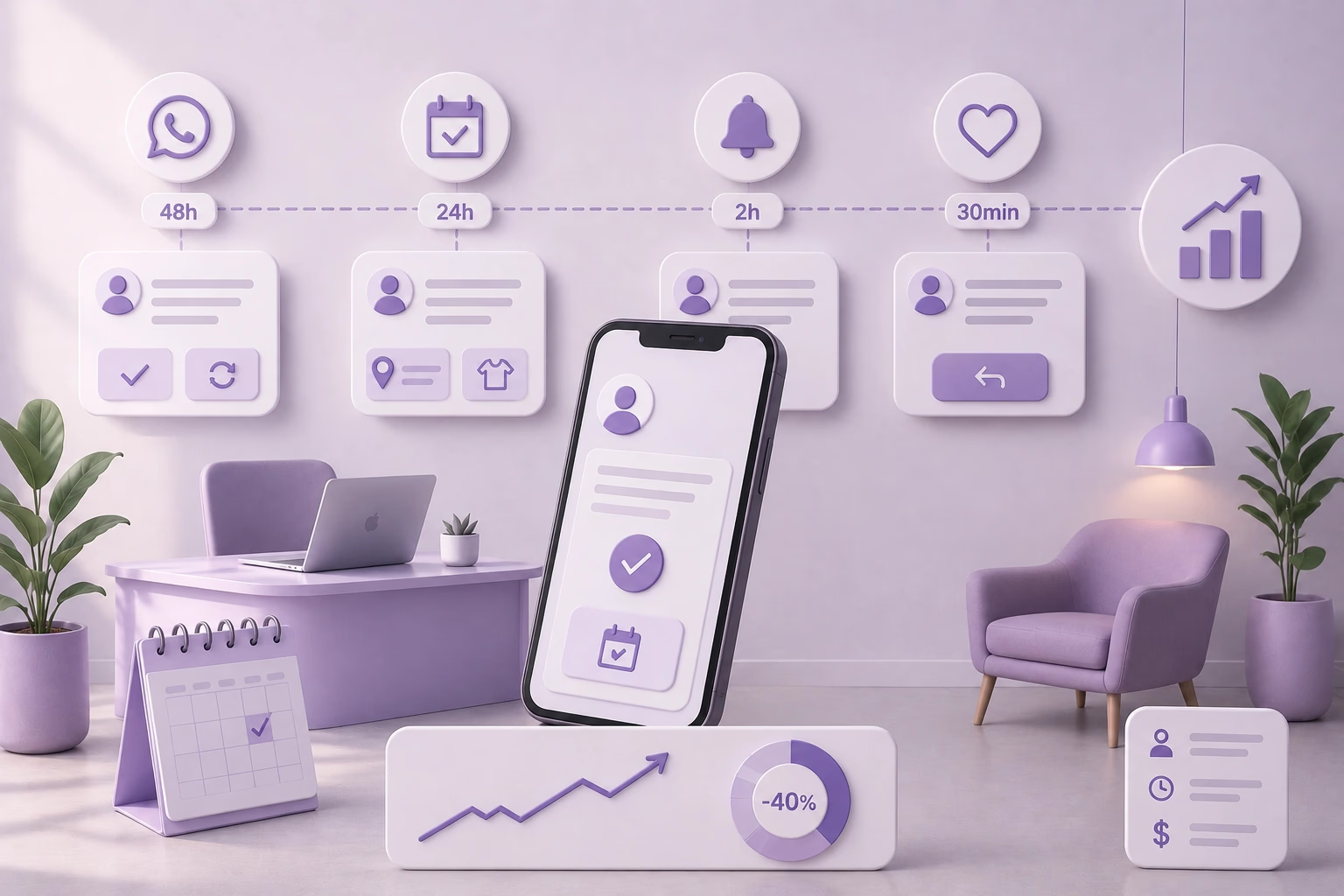
48 Hours Before: The Message That Generates Commitment
The first touchpoint is not a passive reminder. It’s an explicit confirmation request, with minimal friction and an honest exit for anyone who needs to reschedule.
The format that performs best on WhatsApp — the channel with the highest open rate in LATAM, exceeding 95% for business-to-consumer messages according to Meta data — is direct and human:
“Hi [Name], just confirming your appointment for [treatment] on [day] at [time]. Can you confirm you’ll be there? Reply YES to confirm or RESCHEDULE if you need to change it.”
The message has to feel written by a person, not generated by software. Because if the patient detects a bot, the psychological commitment disappears. Basic personalization — name, treatment, specific time — is enough to achieve that effect.
24 Hours Before: Context Differentiated by Behavior
This is where most automated systems fail: they send the same message to everyone.
For those who already confirmed, the 24-hour message should add value, not repeat information. What to bring, how to get there, whether fasting is required, whether to avoid makeup or creams beforehand. This reduces pre-appointment anxiety, improves the patient experience before they’ve even walked through the door, and reinforces the decision to follow through. It’s not marketing — it’s service.
For those who didn’t respond to the confirmation, the tone shifts. More direct, with a prominent rescheduling option. The goal isn’t pressure — pressure generates cancellations, not appearances — but reducing friction for anyone who may have been planning not to come because they didn’t know how to let you know.
This segmentation is technically the simplest part of the system to implement, and the one with the highest impact on results.
2 Hours Before: The Final Touchpoint
Only for patients who still haven’t confirmed. Short, no pressure, with a direct link to reschedule. The tone should be neutral, not urgent.
“Hi [Name], your appointment is in 2 hours. If you need to change it, you can do so here: [link]. If you’re on your way — see you soon!”
The function of this message isn’t to convince anyone. It’s to give a clean exit to whoever has already decided not to come but hasn’t said so. Getting them to reschedule instead of simply disappearing is worth twice as much: you recover the slot for another patient and keep the relationship active.
The Recovery Message: The 30 Most Profitable Minutes of the Day
The most overlooked moment in no-show management is right after it happens. The patient didn’t show, the slot is empty, and the clinic moves on with its day as if nothing occurred. One lost appointment and that’s that.
The system should automatically detect that the patient didn’t arrive — integrated with the practice management software — and send a message within the next 20 to 30 minutes. Not a complaint. Not an aggressive question. An opening:
“Hi [Name], we noticed you weren’t able to make it today. No worries — these things happen. When would work for you to reschedule?”
That message has a response rate of 40–50% in our implementations. And of those who respond, more than 70% book a new appointment within the next 7 days. It’s not a slot recovered today — that one is already gone — but it is a patient who didn’t walk out the door to a competitor.
At scale, that compounding effect is significant. A clinic with 50 monthly no-shows that recovers 35% of those patients through the recovery message gets back between 15 and 18 appointments per month that would otherwise simply vanish.
What the Numbers Look Like After 60 Days
With this full sequence in place, the average no-show reduction we measure in clinics after implementation is between 38% and 42% within the first 60 days of activation.
To put the financial impact in concrete terms: a clinic running 15 daily appointments at an average ticket of $120 USD with a 20% no-show rate (3 lost slots per day) that brings that rate down to 12% recovers between 1.2 and 1.5 slots daily. Over 22 working days per month, that’s between 26 and 33 additional appointments. Between $3,100 and $3,900 USD per month in revenue that was previously evaporating.
That number doesn’t include the time saved by the administrative team that stops making manual confirmation calls — typically 2 to 3 hours per day in mid-sized clinics — nor the indirect effect on patient satisfaction, which according to Accenture Health improves measurably when pre-appointment communication is proactive and personalized.
The Channel Matters as Much as the Message
WhatsApp has open rates no other channel can match in LATAM. But that doesn’t mean it’s the only channel to use, nor that the same text performs equally well across all of them.
SMS remains useful for older patients or those in areas with unreliable connectivity. Email makes sense for more detailed pre-appointment summaries or patients who prefer formality. But the mistake many clinics make is sending the same message, with the same text, through all three channels simultaneously. That’s not omnichannel — it’s spam.
The practical rule: WhatsApp for the first confirmation contact, SMS as backup if there’s no response within 6 to 8 hours, email for pre-appointment context when it applies. And never all three in the same time window.
The other frequent mistake is adding more messages under the assumption that more touchpoints equals more appearances. It doesn’t work that way. Beyond a certain threshold — which depends on the type of clinic and the patient profile — frequency generates irritation and patients start canceling or blocking the number to be left alone. The goal isn’t constant presence; it’s presence at the right moments.
The Real Problem Isn’t the System — It’s the Design
Any reasonably capable automation tool can send messages with configured timing. The differentiator isn’t the technology; it’s how the sequence is designed: what’s said, when, to whom, in what tone, and what happens with the response.
A well-designed reminder system doesn’t just reduce no-shows. It changes how patients perceive the clinic. Research from The Rockefeller Corporation, widely cited in healthcare retention literature, found that 68% of patients who stop attending a clinic do so because they feel indifference from the provider — not because they found a better option. A well-crafted post no-show recovery message does exactly the opposite of indifference: it signals that the patient’s absence was noticed and that they matter.
That’s relationship management, not reminders. And the difference shows up in the numbers.
Frequently Asked Questions
What percentage of no-show reduction is realistic to expect from automated reminders?
Clinics that move from a single day-before reminder to a structured 4-point sequence (48h confirmation, 24h contextual, 2h final, post no-show recovery) typically see a 35% to 45% reduction within the first 60 days. The variables that most affect outcomes are the quality of the message copy, the percentage of patients with active WhatsApp accounts, and whether the system is integrated with the appointment management software to detect absences automatically.
Isn’t it annoying for patients to receive multiple messages before an appointment?
It depends on the design. A passive message that asks for nothing can feel intrusive the second time around. A message that offers useful information or a clear action rarely does. The key is that each message in the sequence serves a distinct function: the first requests confirmation, the second adds contextual value, the third provides a frictionless exit for anyone who can’t make it. If all three say the same thing, the third one just gets in the way.
Does it work the same in medical clinics as in aesthetic clinics?
The mechanics are the same, but the baseline numbers differ. Aesthetic clinics with longer treatment sessions (60 to 90 minutes) tend to have no-shows with higher per-slot economic impact, but also patients more invested in their outcomes, which makes confirmation easier. Medical clinics typically handle higher volumes of shorter appointments and a more varied patient age range. The most important adjustment is tone: more clinical in medicine, more relational in aesthetics.
What tools are used to implement this sequence?
There’s no single answer. Options range from practice management platforms with built-in communication modules to WhatsApp automation tools (such as Wati, Respond.io, or custom solutions via Meta’s API) connected to the existing appointment system. What’s critical is bidirectional integration: the system needs to know when a patient confirmed, when they rescheduled, and when they didn’t show up — in order to trigger the right message in each scenario.
Doesn’t the post no-show recovery message make patients uncomfortable?
The opposite, when it’s written correctly. The tone is everything: it’s not a complaint, it’s not an accusatory question. It’s a frictionless opening. “We noticed you weren’t able to make it — when would work for you to reschedule?” assumes nothing negative about the patient. It gives them control over the situation. And that sense of control is exactly what turns an absence into a recovery.
We diagnose your operation and show you exactly which module solves your bottleneck.